How to Choose an Infrared Dome Manufacturer
How to Choose an Infrared Dome Manufacturer: A Practical OEM Buying Guide
Choosing an infrared dome manufacturer involves more than finding a supplier that can quote your outside diameter.
You need to understand what material will be supplied, how the dome will fit your optical assembly, which coating requirements are included and how the finished component will be inspected.
Start by comparing the technical scope of each offer. Then compare price and delivery against that same scope.
This guide provides a practical framework for evaluating suppliers and preparing an enquiry that can move toward a manufacturing decision.
Prepared by James Fu, International Sales Director at Felix Glass, with 19 years of optical-industry experience.
Have a drawing ready? Send your drawing revision, operating wavelengths and quantities to james@felixglass.com. If the design is preliminary, identify the requirements that remain open.
What Should a Supplier Confirm Before Quoting?
A useful proposal should establish the configuration being offered and disclose any assumptions or exceptions.
| Requirement | What to ask the supplier | What to check in the offer |
|---|---|---|
| Material | Which substrate and grade are proposed? | An identifiable material specification |
| Geometry | Which drawing revision controls manufacture? | Dimensions, tolerances and stated deviations |
| Optical quality | Which surface and optical requirements are included? | Clear aperture, metrics and test conditions |
| Coating | Which bands, angles and surfaces are covered? | Defined performance and coating scope |
| Inspection | How will critical requirements be verified? | Agreed methods and delivery reports |
| Commercial scope | What is included in the quoted price? | Quantity, tooling, testing, packaging and delivery basis |
An unresolved requirement does not automatically disqualify a supplier. What matters is whether it is identified and addressed before the order proceeds.
1. Confirm the Material Grade
ZnSe, standard CVD ZnS and multispectral ZnS should not be treated as interchangeable quotation descriptions.
ZnSe is commonly used for infrared optics, including suitable CO₂ laser applications. Standard ZnS is used for protective thermal-imaging optics, while multispectral ZnS provides visibly clear material for applications that also require visible transmission.
The material grade must still be evaluated against the actual operating band, component thickness and application. A published transmission range is not a finished-component acceptance specification.
Ask: “Please identify the material grade and any proposed substitution in your quotation.”
2. Review the Dome Together with Its Housing
A dome drawing should define more than outside diameter.
Include inner and outer radii, wall thickness, height, clear aperture and mounting features. Show which surfaces contact the housing and identify coating exclusions around seating or bonding areas.
For a concentric spherical shell, check that the specified radii and wall thickness agree. If several dimensions control the same geometry, ensure their tolerances do not create conflicting requirements.
Share a housing section drawing when possible. This gives the manufacturer context for the rim, flange, seating surfaces and available clearances.
Ask: “Please identify any geometry or mounting features that require clarification before manufacture.”
3. Define Optical Quality Beyond Surface Appearance
A scratch-dig specification describes surface imperfections. It does not establish the dome’s complete effect on an imaging system.
Depending on the application, requirements may also include surface figure, roughness or transmitted wavefront performance.
For each requirement, define the relevant clear aperture and inspection conditions. Avoid adding demanding numerical limits without identifying how they will be measured and why the system needs them.
Ask: “Which optical requirements can be verified on the finished dome, and what test configuration is proposed?”
4. Make AR Coating Requirements Comparable
“Both sides AR coated” leaves too much uncertainty for a reliable comparison.
Specify the operating bands, incidence angles, required performance and surfaces to be coated. Distinguish minimum transmission from average transmission.
For a curved component, request coating evaluation against the relevant ray angles rather than assuming that a normal-incidence result represents the complete field of view.
If durability matters, define it separately through the applicable exposure conditions and test criteria.
Ask: “Does the proposed performance apply to the finished dome or a witness sample, and under what measurement conditions?”
5. Check What the Inspection Report Will Demonstrate
Agree on inspection scope before placing the order.
A dimensional report, material record and coating witness-sample curve provide different types of information. None should be assumed to demonstrate requirements outside its stated scope.
Where witness samples are used, establish their relationship to the batch and identify which checks still apply to the finished component.
Ask: “Please list the inspection documents included with delivery and any requirements that need an alternative verification method.”
A Quotation Comparison Example
Consider two offers for a dome intended for an 8–14 μm system.
Offer A states only “ZnS, double-sided AR coating.” Offer B identifies the ZnS grade, proposed spectral limits, measurement conditions and inspection documents.
Offer B is easier to assess, but neither offer should be accepted without checking the actual requirement—including performance at the long-wavelength end of the band.
The practical next step is to request the missing information from Offer A and evaluate both offers against the same specification.
A more detailed quotation is not automatically a better component. It provides a clearer basis for making the decision.
Use Prototypes to Resolve Defined Risks
Tell the supplier what the first samples need to demonstrate.
A fit-check sample may answer a housing question without proving final optical performance. An uncoated prototype cannot establish the transmission of the planned coated component.
Before ordering, agree on the sample configuration, evaluation goals and any differences from the intended production design.
After testing, update the controlled drawing and specifications. Record approved deviations rather than relying on informal references to a previous sample.
Discuss Your Project with Felix Glass
James Fu is the international sales contact for custom optical component enquiries at Felix Glass.
To begin a useful discussion, send the requirements you have and identify what remains undecided. Your enquiry can focus on a finished drawing, material alternatives, prototype evaluation or preparation for repeat production.
For an initial enquiry, these four items are a useful starting point:
- Drawing or dimensioned sketch
- Operating wavelength band
- Prototype and expected production quantities
- Target delivery date
Add material, coating, optical quality and inspection requirements where available.
If the design is preliminary, mark it accordingly. Any budgetary proposal should state its assumptions and the information needed before a firm manufacturing commitment.
Frequently Asked Questions
Can I request a quotation without a final drawing?
You can start a preliminary discussion with a dimensioned sketch, application details and quantities. A firm quotation requires enough information to define the component and acceptance requirements.
Can two domes with the same diameter have different prices?
Yes. Material grade, wall geometry, tolerances, coating, inspection and order scope may differ. Compare those details before comparing unit prices.
Does an AR coating guarantee high transmission across the entire infrared band?
An AR coating should be evaluated against a defined wavelength band and measurement conditions. Its presence alone does not establish a transmission level.
Can a product photograph confirm the material or coating?
A photograph can illustrate appearance. Material identity and coating performance should be established through the agreed documentation and testing.
What should I send first?
Send your available drawing, wavelength band and quantities. Identify the main question you need resolved so the discussion can focus on the next engineering or purchasing decision.
Send Your Infrared Dome Requirements
Email subject: Custom Infrared Dome RFQ — [Material / Diameter / Quantity]
Contact: James Fu, International Sales Director
Company: FELIX OPTICAL GLASS
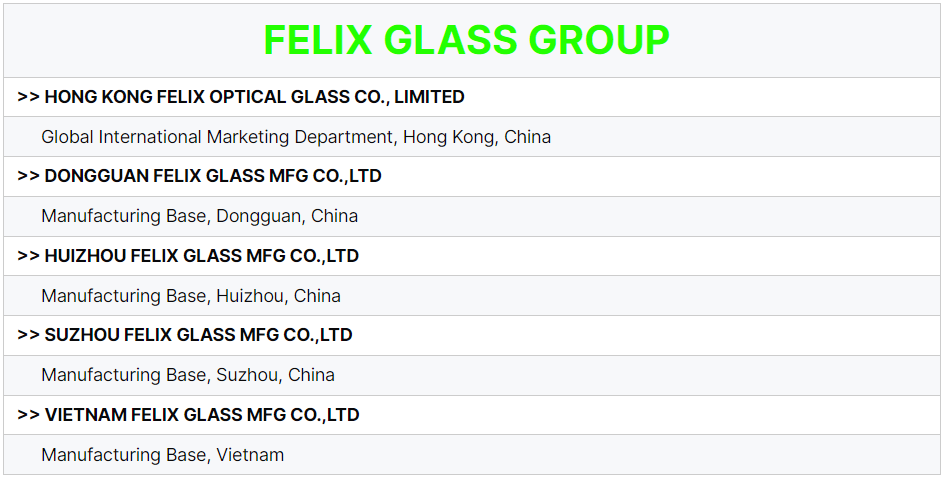
Manufacturing entity: Dongguan Felix Glass Co., Ltd.
Email: james@felixglass.com
Website: https://www.felixglass.com/
Attach your drawing and tell us what the dome must achieve.