ZnS vs ZnSe: Complete Infrared Optical Material Selection Guide
ZnS vs ZnSe: Complete Infrared Optical Material Selection Guide
ZnS (Zinc Sulfide) and ZnSe (Zinc Selenide) are among the most widely used infrared optical materials for thermal imaging, infrared surveillance, laser systems, aerospace optics, scientific instrumentation, and industrial sensing applications.
Both materials belong to the II-VI semiconductor crystal family and provide excellent infrared transmission. They are commonly manufactured into infrared lenses, optical windows, domes, prisms, and custom optical components.
Although ZnS and ZnSe appear similar and share overlapping infrared transmission ranges, they differ significantly in optical performance, hardness, environmental durability, laser compatibility, coating behavior, and overall system cost.
Selecting the wrong material can lead to reduced transmission efficiency, optical distortion, premature surface degradation, coating failure, and shortened system lifetime.
This guide provides engineers, optical designers, and procurement professionals with a comprehensive comparison of ZnS and ZnSe, including material properties, spectral performance, application boundaries, failure analysis, and selection recommendations.
Reviewed by: Senior Optical Engineer
Last Updated: June 2026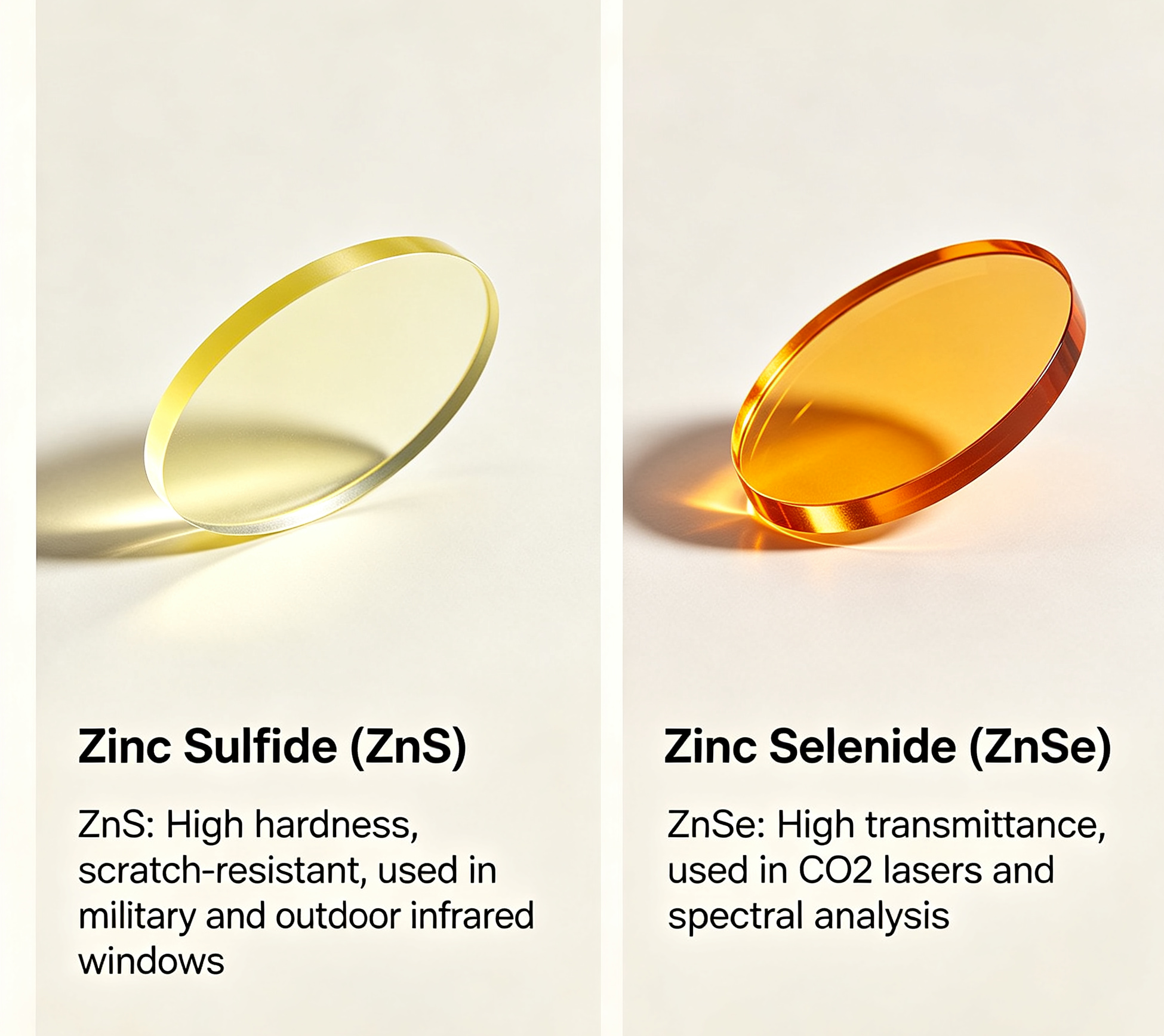
1. Core Material Property Comparison
The fundamental differences between ZnS and ZnSe originate from their crystal structure, refractive index, hardness, thermal characteristics, and environmental resistance.
Basic Physical Parameters
| Parameter | ZnS (Zinc Sulfide) | ZnSe (Zinc Selenide) |
|---|---|---|
| Transmission Range | 3 μm – 14 μm | 0.6 μm – 18 μm |
| Refractive Index @10 μm | 2.25 | 2.40 |
| Mohs Hardness | 3.0 | 2.8 |
| Density | 4.09 g/cm³ | 5.27 g/cm³ |
| Thermal Expansion | Lower | Higher |
| Optical Absorption | Moderate | Very Low |
| Weather Resistance | Excellent | Moderate |
| Laser Compatibility | General IR Systems | High-Power CO₂ Laser |
| Relative Cost | Economical | Premium |
Key Differences Summary
ZnS Advantages
- Better mechanical durability
- Improved resistance to humidity and harsh environments
- Lower manufacturing cost
- Suitable for large-scale industrial deployment
ZnSe Advantages
- Wider transmission spectrum
- Lower optical absorption
- Better multispectral performance
- Preferred material for high-power laser systems
2. Infrared Transmission Spectrum Comparison
Transmission performance is often the most important factor in optical material selection.
ZnS vs ZnSe Transmission Range
| Wavelength | ZnS | ZnSe |
|---|---|---|
| 0.6 μm | × | ✓ |
| 1 μm | × | ✓ |
| 3 μm | ✓ | ✓ |
| 5 μm | ✓ | ✓ |
| 8 μm | ✓ | ✓ |
| 10.6 μm | ✓ | ★★★★★ |
| 14 μm | ✓ | ✓ |
| 18 μm | × | ✓ |
ZnSe provides broader spectral coverage extending from visible wavelengths into the long-wave infrared region.
ZnS is optimized for conventional MWIR and LWIR applications where environmental stability and cost efficiency are priorities.
3. Spectral Performance Analysis
ZnS Spectral Characteristics
ZnS performs exceptionally well within the 3–14 μm infrared band.
Advantages include:
- Stable transmission
- Low spectral drift
- Excellent thermal imaging performance
- Consistent operation under changing temperatures
Limitations:
- Poor visible light transmission
- Not suitable for multispectral optical systems
ZnSe Spectral Characteristics
ZnSe supports transmission from visible wavelengths through far infrared.
Advantages include:
- Ultra-low absorption at 10.6 μm
- Excellent multispectral capability
- Flat transmission profile
- High-performance optical imaging
Limitations:
- Softer surface
- Increased susceptibility to scratches
- Greater environmental sensitivity
4. Mechanical and Environmental Stability
ZnS: Harsh Environment Material
ZnS offers superior durability in demanding environments.
Suitable for:
- Vehicle-mounted thermal cameras
- Outdoor surveillance systems
- Industrial process monitoring
- Military infrared observation devices
Performance benefits include:
- Better abrasion resistance
- Improved humidity resistance
- Reduced maintenance requirements
ZnSe: Controlled Environment Material
ZnSe is preferred when optical performance outweighs environmental concerns.
Typical applications include:
- Scientific instrumentation
- Precision imaging systems
- Laboratory equipment
- Laser optics
Protective coatings are strongly recommended for outdoor deployment.
5. Laser System Compatibility
Why ZnSe Dominates CO₂ Laser Systems
ZnSe is considered the industry standard for CO₂ laser optics.
Benefits include:
- Extremely low absorption at 10.6 μm
- Reduced thermal lensing
- Higher laser damage threshold
- Stable beam quality
Common applications:
- Laser cutting
- Laser welding
- Laser marking
- Medical laser equipment
ZnS Limitations in Laser Applications
ZnS is generally not recommended for high-power CO₂ laser transmission due to higher absorption and thermal loading.
6. Coating Compatibility
ZnS Coating Characteristics
- Strong coating adhesion
- Excellent thermal cycling resistance
- Reliable infrared AR coating performance
ZnSe Coating Characteristics
- Supports advanced multispectral coatings
- Requires stricter process control
- Capable of transmission exceeding 98% at 10.6 μm
7. Material Selection Flowchart
How to Select Between ZnS and ZnSe
-
1.Need CO₂ Laser? → Yes → Choose ZnSe
-
2.Need Visible + Infrared Transmission? → Yes → Choose ZnSe
-
3.Need Outdoor Durability? → Yes → Choose ZnS
-
4.Need Lowest Cost? → Yes → Choose ZnS
-
5.Need Maximum Optical Performance? → Yes → Choose ZnSe
8. Real Industry Application Examples
Thermal Imaging Camera
Recommended Material: ZnS
Reasons:
- Better environmental resistance
- Longer service life
- Lower maintenance cost
CO₂ Laser Cutting Head
Recommended Material: ZnSe
Reasons:
- Lowest absorption
- Excellent beam transmission
- Industry-standard solution
UAV Infrared Surveillance System
Recommended Configuration:
- ZnS Protective Dome
- ZnSe Internal Lens Assembly
Benefits:
- Extreme field durability
- High optical efficiency for multispectral detection
9. ZnS and ZnSe Compared with Other Infrared Materials
| Material | Transmission Range | Hardness | Relative Cost |
|---|---|---|---|
| ZnS | 3–14 μm | High | $$ |
| ZnSe | 0.6–18 μm | Medium | $$$ |
| Germanium | 2–14 μm | Very High | $$$$ |
| Silicon | 1–7 μm | Very High | $$ |
| Chalcogenide Glass | 1–12 μm | Low | $$$ |
10. Common Failure Problems and Solutions
Problem: Low Transmission After Outdoor Exposure
Cause: Surface oxidation or coating degradation.
Solution: Use ZnS or apply professional protective infrared AR coatings.
Problem: Image Blur and Scattering
Cause: Surface scratches on unprotected ZnSe.
Solution: Upgrade to ZnS for harsh field environments.
Problem: Thermal Distortion & Lens Burn
Cause: Incorrect material selection for high-power laser systems.
Solution: Use ZnSe exclusively for CO₂ laser optical assemblies.
11. Custom Machining Capabilities
ZnS Manufacturing Strengths
Suitable for:
- Infrared windows
- Optical domes
- Large-format industrial optics
Benefits:
- Superior dimensional stability
- Minimal polishing deformation
- High yield rate for large-size components
ZnSe Manufacturing Strengths
Suitable for:
- Precision laser lenses
- Meniscus correction lenses
- High-end multispectral optics
Benefits:
- Ultra-smooth optical surface finish
- Sub-nanometer precision polishing
- Consistent beam transmission performance
12. Frequently Asked Questions
Q1: Which material is better, ZnS or ZnSe?
Neither material is universally better.
ZnS delivers outstanding durability and cost-effectiveness for industrial IR systems.
ZnSe delivers superior optical performance and multispectral capability for high-end laser & aerospace systems.
Q2: Can ZnSe be used outdoors?
Yes, but dedicated anti-humidity and infrared protective coatings are mandatory for long-term outdoor deployment.
Q3: Is ZnS suitable for laser optics?
ZnS is not recommended for high-power CO₂ laser transmission due to higher thermal absorption.
Q4: Can both materials be used in one optical assembly?
Yes. Most modern defense and UAV multispectral systems combine ZnS outer protective optics and ZnSe inner precision lens groups for balanced durability and imaging quality.
13. About Felix Glass
Felix Glass specializes in precision infrared optical manufacturing and custom optical solutions for global industrial, defense, aerospace, and scientific clients.
Our core infrared product lineup includes:
- ZnS infrared windows
- ZnS optical domes
- ZnSe laser lenses
- ZnSe optical blanks
- Multispectral ZnSe dome lenses
- Custom infrared optical components
We support prototype validation, small-batch trial production, and full-scale mass manufacturing for mission-critical optical systems.
14. Technical Review
Reviewed by: Senior Infrared Optical Engineer
Expertise: Infrared Optical Design, Thermal Imaging Systems, EO/IR Integration, Aerospace Infrared Optics, Infrared Material Engineering
Department: Felix Glass Optical R&D Team
Related Articles
- Infrared Optical Materials Performance Guide
- How to Select Infrared Windows for Thermal Imaging Systems
- Germanium vs ZnSe Optical Material Comparison
- Infrared Dome Material Selection Guide
Related Products
- ZnS Optical Components
- ZnSe Optical Components
- Infrared Optical Lenses
- Infrared Optical Windows
- Infrared Optical Domes
Get a Custom Quote
Share your wavelength requirements, operating environment parameters, optical drawings, or application details.
Our professional optical engineering team will provide accurate material evaluation, process recommendations, and factory-direct customized infrared optical solutions.