Application-Based Optical Comparison | IR Material Selection Guide
Application-Based Optical Comparison
Choosing the wrong infrared material leads to lens burn, window scratching, poor image quality or shortened service life. This guide compares four mainstream IR materials (ZnSe, ZnS, Silicon, Germanium) strictly by end-use application, so you can select optics without complex material theory.
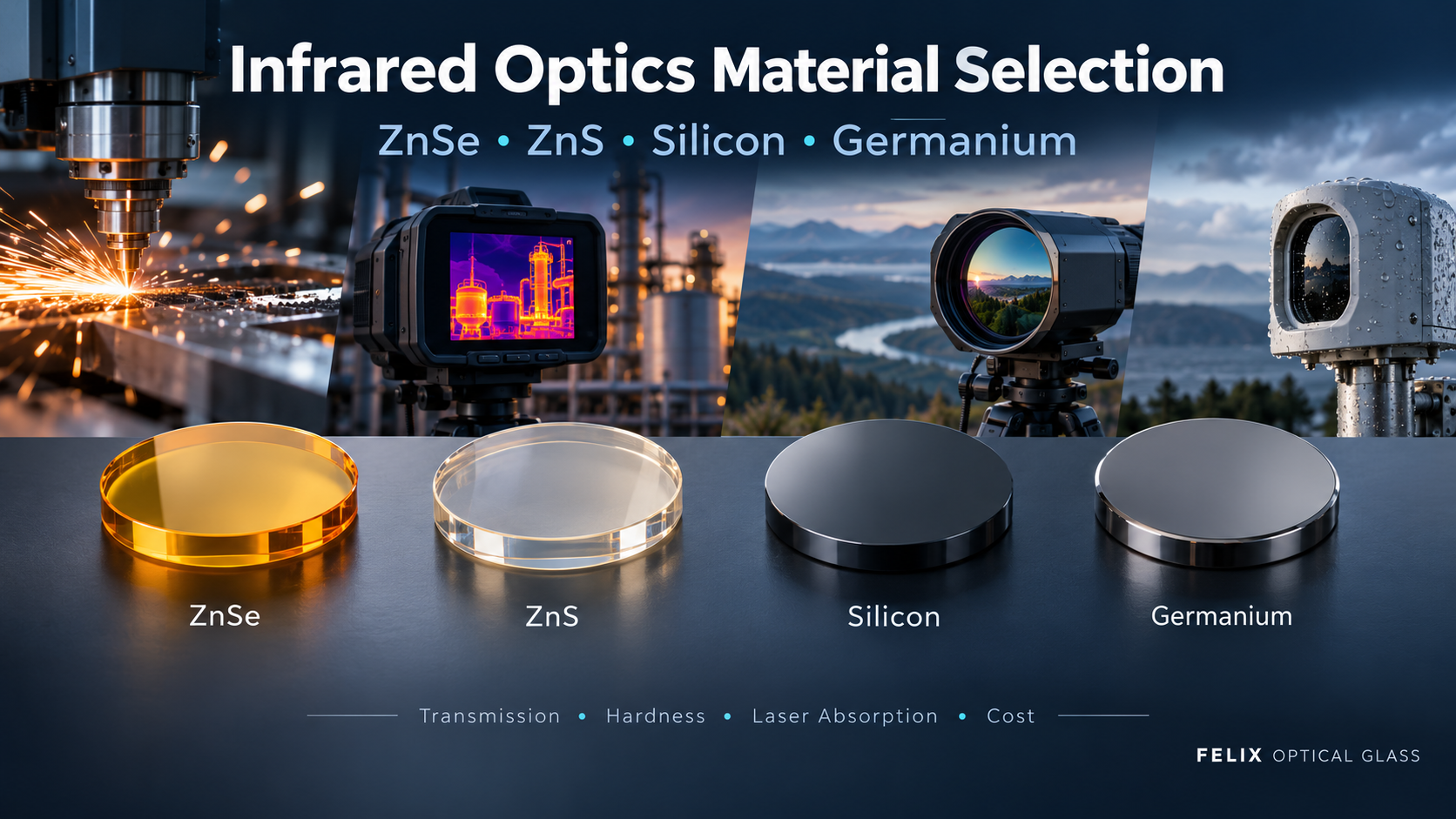
Core Material Parameter Overview
| Material | Spectral Range (μm) | Knoop Hardness | 10.6 μm Absorption | Visible Light Transmission |
|---|---|---|---|---|
| ZnSe (CVD) | 0.6 ~ 21 | 120 (soft) | Extremely low | Transmits red aiming beam |
| Multi-spectral ZnS | 0.4 ~ 13.5 | 160 (hard) | Medium | Full visible transmission |
| Silicon (Si) | 1.2 ~ 7 | 1150 (very hard) | High | Opaque |
| Germanium (Ge) | 1.8 ~ 14 | 780 (hard) | High | Opaque |
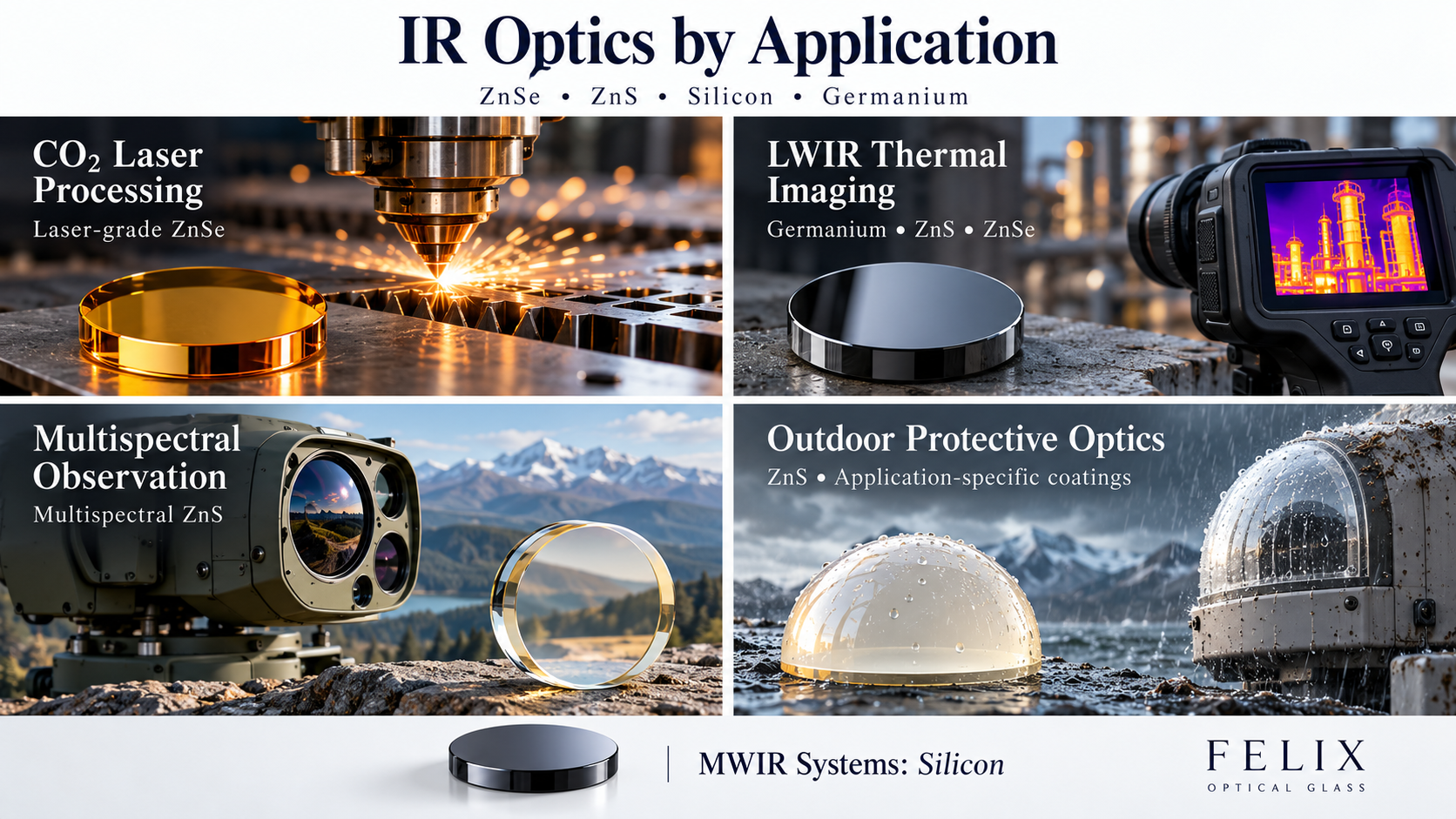
1. CO₂ Laser Cutting & Engraving (10.6 μm) – Top Priority
- ✅ First choice: ZnSe. Ultra-low absorption prevents thermal lensing; supports high-power CW laser; compatible with red diode alignment beam.
- ❌ Not recommended: ZnS, Si, Ge. Higher absorption causes lens overheating and burn damage under high laser power.
- Coating match: Single-band AR @10.6μm or dual-band AR for laser + aiming light.
2. Thermal Imaging & LWIR Cameras (8–14 μm)
- ✅ First choice: Germanium. High refractive index for compact lens design; high hardness for indoor camera windows.
- ✅ Outdoor rugged version: Multi-spectral ZnS. Harder than ZnSe, scratch-resistant for vehicle-mounted and field equipment.
- ❌ Silicon: Only works for MWIR (3–5 μm), cannot cover 8–14 μm thermal band.
3. Multi-Spectral Observation (Visible + MWIR + LWIR)
- ✅ Best pick: Multi-spectral ZnS. Covers visible light to 13.5 μm; one optic for both daytime visible sight and night thermal imaging.
- Alternative: ZnSe, but softer and easier to scratch in exposed airborne dome applications.
- Ge & Si: Block visible light, cannot support multi-band coaxial observation.
4. Rugged Outdoor & Vehicle/Airborne Protective Windows
- High mechanical impact, dust, sand, moisture: ZnS > Ge > ZnSe
- ZnSe is too soft; without DLC coating, it gets scratched easily in harsh field environments.
- Coating upgrade: Add DLC diamond-like carbon coating to boost scratch and moisture resistance.
5. MWIR Only Systems (3–5 μm) – Cost-Optimized Selection
- ✅ First choice: Silicon. Extremely hard, low cost, lightweight; ideal for MWIR thermal detectors and spectroscopy windows.
- Ge is also usable but costs significantly higher than silicon for pure 3–5 μm applications.
Quick Decision Table (By Application)
| Application | Recommended Material | Second Option | Material To Avoid |
|---|---|---|---|
| High-power CO₂ laser optics | ZnSe | None | ZnS, Si, Ge |
| Indoor LWIR thermal imaging | Germanium | ZnS | Silicon |
| Multi-spectral day-night observation | Multi-spectral ZnS | ZnSe | Si, Ge |
| Outdoor rugged IR windows & domes | ZnS (with DLC) | Germanium | Uncoated ZnSe |
| MWIR (3–5 μm) only systems | Silicon | Germanium | ZnSe, ZnS |
Coating Matching Rules for Each Material
- ZnSe: 10.6μm AR, dual-band AR, high LDT coating for laser power
- ZnS: Multi-spectral BBAR + DLC hard coating for outdoor domes
- Germanium: LWIR 8–14μm BBAR coating
- Silicon: MWIR 3–5μm AR coating
Felix Glass Supply Capacity
We produce CVD ZnSe, multi-spectral ZnS, silicon and germanium optics including plano windows, curved domes and focusing lenses. We provide precision polishing, scratch-dig up to 20/10, plus customized AR / DLC coatings. Custom drawings and bulk OEM orders are fully supported.
Get Material Selection Support
Send your working wavelength, environment and power level, we will recommend the most cost-effective material and coating solution.
Request Material Recommendation & Quotation