Infrared Optical Material Comparison
Infrared Optical Material Comparison
Choosing an infrared optical material means balancing spectral transmission, image quality, temperature behavior, mechanical durability and manufacturing requirements. No single material is the best choice for every infrared lens, window or dome.
This guide compares zinc selenide, zinc sulfide, germanium, silicon, sapphire and chalcogenide glass, with fused silica and calcium fluoride as additional references. It provides a screening framework for engineers and procurement teams, rather than a list of interchangeable materials.
1. Start with the System Requirements
The first question is the required wavelength band. A mechanically strong window is unsuitable if it absorbs the radiation needed by the detector. The next questions are what the component must do, where it operates and how performance will be verified.
- Optical function: imaging lens, protective window, dome, filter substrate or laser optic.
- Spectral task: single wavelength, broadband imaging or multiple simultaneous channels.
- Environment: temperature, pressure, abrasion, moisture and cleaning exposure.
- Acceptance criteria: transmission, wavefront error, surface quality and environmental tests.
Separate mandatory requirements from preferences. This creates room to compare alternative designs without weakening the conditions necessary for the application.
2. Infrared Material Comparison at a Glance
| Material | Typical design context | Main reason to evaluate it | Main qualification issue |
|---|---|---|---|
| ZnSe | Broad infrared optics and 10.6 µm CO₂ laser optics | Broad transmission and suitable low-absorption grades | Surface protection, absorption and coating performance |
| Standard ZnS | Infrared protective windows and domes | Infrared transmission with useful mechanical properties | Grade, scatter and band-edge performance |
| Multispectral ZnS | Visible and infrared shared apertures | Improved visible clarity and reduced scatter | Multi-band coatings and grade-specific mechanical properties |
| Germanium (Ge) | MWIR/LWIR optical designs | High refractive index | Thermal behavior, mass and interface reflection |
| Silicon (Si) | Selected SWIR/MWIR optics and specialty IR uses | Relatively low density and high refractive index | Grade-dependent absorption and actual spectral coverage |
| Sapphire | Durable windows for suitable UV, visible, NIR and MWIR bands | Surface hardness and environmental durability | Long-wavelength cutoff, orientation and birefringence |
| Chalcogenide glass | Composition-specific infrared lens systems | Design flexibility and potential molding routes | Exact glass type, thermal properties and process qualification |
| Fused silica | Visible/NIR and selected SWIR optics | Established optical processing and suitable grades | OH content and infrared absorption; not a standard LWIR window |
| Calcium fluoride (CaF₂) | UV-to-infrared instruments within the qualified band | Low refractive index and useful dispersion characteristics | Grade, long-wavelength absorption and mechanical handling |
These categories identify starting points for evaluation. They do not imply that every material supports every wavelength in a broad band label or that the same geometry can be used without redesign.
3. Compare Spectral Curves, Not Just Endpoints
A published transmission range can represent a low threshold at the absorption edge. It does not necessarily describe high transmission across the entire interval.
For example, Crystran lists nominal ranges of 0.6–21 µm for ZnSe and 0.17–5.5 µm for sapphire [1, 5]. Neither statement is a complete specification for a coated window. Thickness, temperature, material quality and the required transmission threshold still matter.
For SWIR systems, check the actual detector range and absorption features. For MWIR, verify performance across the intended interval rather than assuming the entire 3–5 µm region is equally usable. For LWIR, examine the long-wavelength end carefully, especially when extending a requirement toward 14 or 15 µm.
Use curves measured under comparable conditions. Internal transmission, uncoated total transmission and coated finished-part transmission are different quantities.
4. Zinc Selenide: Broad Infrared Transmission
ZnSe is an established material for infrared optical components, including CO₂ laser optics at 10.6 µm [1]. It is worth considering where broad infrared transmission is important.
Laser use requires more than a material label. Define operating wavelength, power or pulse conditions, beam size, permitted absorption, coating performance and thermal conditions. “Infrared grade” should not automatically be accepted as equivalent to a qualified laser grade.
For protective windows, evaluate abrasion, cleaning and handling as part of the design. A coating or separate protection strategy may be necessary depending on exposure.
For imaging, verify transmitted wavefront or lens performance alongside transmission. A high-throughput component can still reduce image quality if surface form, alignment or material homogeneity is inadequate.
5. Zinc Sulfide: Standard vs Multispectral Grade
ZnS offers an important distinction between standard and multispectral material. Additional processing of multispectral ZnS improves optical clarity and reduces scatter, making it useful for systems that share a visible and infrared aperture [2].
Improved optical clarity does not mean improved performance in every category. Supplier comparisons show differences in hardness and flexural strength between standard ZnS and converted multispectral grades [2]. Match the grade to the relevant requirements.
For a thermal-only window, decide whether the multispectral advantages are necessary. For a visible-plus-IR window, specify both channels: the substrate, coating and surface quality must support each one.
CLEARTRAN® is a trade name, not a blanket designation for every multispectral ZnS product. Where an exact material is required, obtain approval before using a proposed equivalent.
6. Germanium and Silicon: High-Index Materials with Different Constraints
Germanium and silicon both offer high refractive indices, but their spectral and thermal behavior differ. Germanium is widely represented in thermal-infrared designs; silicon is commonly used in the 3–5 µm region and other grade-dependent applications [3, 4].
Germanium's refractive index changes significantly with temperature, and elevated temperature can also reduce transmission. Athermalization and thermal management must be assessed at system level [3]. Refocusing does not recover radiation lost to absorption.
Silicon's lower density can be attractive where mass matters. However, impurities, growth method, resistivity and thickness influence its infrared transmission. A broad nominal range does not make ordinary silicon a guaranteed full-band LWIR substitute [4].
For either material, evaluate coating losses and the exact optical prescription. Their high indices can reduce the curvature needed for a given optical power, while increasing uncoated reflection at an air interface.
7. Sapphire, Fused Silica and Calcium Fluoride
Sapphire
Sapphire is relevant when a durable transparent window is required within its usable band. Its crystallographic orientation and birefringence may matter for polarization-sensitive or precision imaging applications. It is not a standard substitute for an 8–14 µm transmissive window [5].
Fused silica
Fused silica can be suitable for visible, near-infrared and selected SWIR work. Specify the grade and consider hydroxyl-related absorption where it affects the wavelength of interest. The phrase “infrared quartz” does not establish compatibility with thermal LWIR imaging.
Calcium fluoride
CaF₂ is another candidate for optical systems operating within its qualified transmission band. Its low index and dispersion can be useful, but the actual grade, thickness and environmental requirements remain part of the selection [7].
These materials help illustrate why “infrared” is too broad a procurement description. A component suitable for a 940 nm sensor can be unsuitable for a 10 µm thermal camera.
8. Chalcogenide Glass: Specify the Exact Composition
Chalcogenide glasses are a family of infrared materials rather than one interchangeable substance. Different compositions have different transmission, dispersion, thermal response and processing characteristics.
SCHOTT publishes separate optical and thermal data for individual IRG glasses, including thickness-defined internal-transmission curves [6]. Use the exact material identifier and a validated optical model in a design.
Some compositions can support precision molding, which may be useful for repeat production of suitable lens shapes. Tooling, glass compatibility, tolerances and coating processes still need qualification; molding is not automatically the lowest-cost route for every quantity.
A favorable thermo-optic coefficient can help an athermal design, but does not make a complete objective athermal by itself. Lens spacing, mechanical expansion and detector position also contribute.
9. Refractive Index, Reflection and Mass
| Material | Refractive index | Density, approximately | Ideal single-surface reflection in air |
|---|---|---|---|
| ZnSe | 2.4028 at 10.6 µm | 5.27 g/cm³ | 17.0% |
| Multispectral ZnS | 2.2008 at 10 µm | 4.09 g/cm³ | 14.1% |
| Ge | 4.0026 at 11 µm | 5.33 g/cm³ | 36.0% |
| Si | 3.4223 at 5 µm | 2.33 g/cm³ | 30.0% |
Reference values are from [1–4, 8]. The wavelengths differ, so this table is not a same-wavelength optical design comparison. The reflection estimates use R = ((n − 1)/(n + 1))² at normal incidence for an ideal lossless interface. They exclude coatings and bulk absorption.
Density alone does not determine final component mass. For a simple window, mass equals density multiplied by volume. For lenses, a different index may require a different shape, thickness or element count, so compare complete feasible designs.
10. Compare Thermal and Mechanical Behavior Separately
Thermal evaluation should include refractive-index change, expansion, conductivity, absorption and temperature gradients. A material with a favorable value in one category can still create difficulties elsewhere.
Mechanical evaluation should distinguish hardness, stiffness, fracture toughness and strength. Hardness relates to resistance to indentation or scratching; it is not a pressure rating. Strength also depends on defects, surface condition, geometry and loading.
- Pressure windows: assess unsupported span, thickness, mount and seals.
- Exposed optics: qualify abrasion, cleaning, moisture and thermal cycling as required.
- Precision lenses: evaluate focus and alignment over temperature.
- Weight-sensitive assemblies: assess component and mounting mass together.
Compare material test data only when methods and conditions are compatible. A bulk datasheet value does not guarantee the performance of a finished assembly.
11. Coating and Manufacturing Can Change the Selection
A usable substrate still needs a manufacturable surface and a suitable coating. AR performance, protective layers, coating stress, adhesion and environmental resistance all belong in the comparison.
For a dual-band window, define transmission in both bands. A coating optimized for one channel may reduce performance in the other. For a lens or dome, consider the distribution of incidence angles rather than only normal-incidence witness data.
Geometry also affects manufacturing. Large apertures, thin walls, steep aspheres, tight centration and demanding edge features can alter yield and inspection needs. A material that works well for a small flat window may be less suitable for a large thin dome.
Compare total project cost: raw material, tooling, machining, coating, inspection, qualification and expected production yield. Avoid a universal “cheapest material” ranking without an actual drawing and quantity.
12. Match Candidate Materials to the Application
| Application | Candidates to investigate | Decisive checks |
|---|---|---|
| Visible/NIR sensor cover | Suitable glass, fused silica, sapphire | Wavelength, durability, coating and image quality |
| SWIR inspection optics | Suitable optical glasses, fused silica, sapphire or other band-compatible materials | Actual detector range and absorption features |
| MWIR window or lens | Si, ZnSe, ZnS, selected chalcogenide glasses; sapphire where its band is sufficient | Thickness, operating wavelength and thermal conditions |
| LWIR protective window | ZnS or ZnSe, with other materials assessed against the exact specification | Long-wavelength transmission and environmental exposure |
| Visible-plus-LWIR aperture | Multispectral ZnS as an initial candidate | Scatter, visible image quality and dual-band coating |
| 10.6 µm CO₂ laser optic | Qualified low-absorption ZnSe | Absorption, power loading, coating and thermal management |
| Repeated production of IR aspheres | Exact chalcogenide grades or other machinable IR substrates | Optical design, process route, tooling and production economics |
The table is an engineering shortlist, not an approval to substitute materials. Each candidate must pass the application's spectral, optical, mechanical and environmental requirements.
13. A Material Selection and Substitution Checklist
- Define exact wavelengths and whether visible alignment or imaging is also required.
- Confirm detector response, optical function and working geometry.
- Compare transmission at realistic thicknesses and operating temperatures.
- Check index, dispersion, homogeneity and thermal data using validated models.
- Review the mount, loads, cleaning and environmental exposure.
- Evaluate coatings and the manufacturing route for the actual geometry.
- Recalculate the optical design for any material change.
- Agree on measurable finished-part acceptance criteria.
- Validate prototypes before accepting a production substitution.
For a lens, changing material without changing curvature generally changes focal length and aberrations. For a flat window, it changes optical path, reflection and potentially focus or wavefront behavior. “Same dimensions” does not establish functional equivalence.
Material certificates and typical datasheet values support the review, but do not replace complete-part measurements when these are required by the specification.
14. Frequently Asked Questions
Which infrared optical material is best?
There is no universal winner. Choose against the exact spectral band, optical function, environment, geometry and acceptance criteria.
Is ZnS better than ZnSe?
It depends on the task. Compare the required transmission, material grade, durability, absorption and coating. A protective window and a high-power laser lens can lead to different decisions.
Does multispectral ZnS always have better mechanical properties?
No. Processing improves optical behavior but can change mechanical properties. Compare grade-specific supplier data under compatible test conditions.
Can sapphire replace an LWIR window because it is harder?
Not for a conventional full-band 8–14 µm transmissive application. Spectral compatibility must be established before mechanical advantages are considered.
Is silicon a direct replacement for germanium?
No. Their spectral response, index, dispersion and thermal behavior differ. A substitution requires a new optical and integration assessment.
Are all chalcogenide glasses equivalent?
No. Use the exact composition or approved grade. Optical and thermal properties vary, and similar names do not prove interchangeability.
Does a coating make an unsuitable substrate transmit the required band?
No. AR coatings reduce interface reflection; they do not remove intrinsic bulk absorption. Protective coatings may introduce additional losses that must be included.
What information is needed for a material recommendation?
Provide the exact wavelength band, drawing, thickness, optical-quality targets, operating environment, coating needs and quantities. Identify which requirements are fixed and which may be optimized.
15. Discuss Your Infrared Material Requirements with Felix Glass
A useful material recommendation starts with the component's role in the complete system. Share the optical and mechanical requirements together so material, coating, geometry and inspection can be reviewed as one specification.
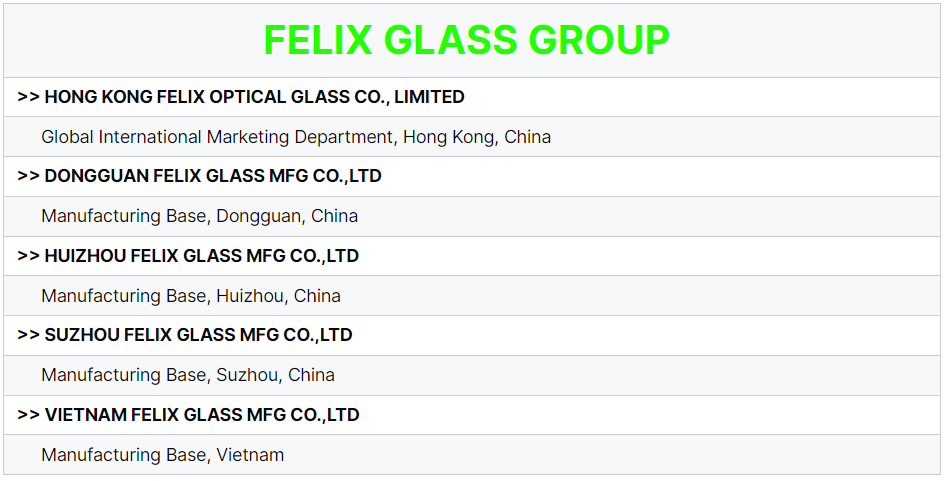
Felix Glass focuses on custom precision optical components. For projects involving ZnSe, ZnS, silicon, sapphire and other suitable materials, manufacturing feasibility and finished-part performance should be confirmed against the final drawing.
Request an Optical Material Review
Send your PDF drawing and STEP file, if available, with the operating band, environmental conditions, prototype quantity and production requirements.
Discuss Your Optical Component
Email: james@felixglass.com
Dongguan Felix Glass Co., Ltd.
Explore the Infrared Optics Guide
Related articles: Infrared Imaging Principles; Germanium (Ge) Lens Guide; ZnS Infrared Window Explained; IR Transmission Range Guide (8–15 µm).
Technical References
- Crystran: Zinc Selenide — optical constants, density and infrared applications.
- Hellma Materials: Zinc Sulfide and Cleartran — grade-dependent optical and mechanical properties.
- Crystran: Germanium — representative index, density and thermal behavior.
- Crystran: Silicon — applications and material properties.
- Crystran: Sapphire — spectral and crystallographic considerations.
- SCHOTT: Infrared Glasses and Materials — composition-specific optical and thermal data.
- Crystran: Calcium Fluoride Guide — grade and wavelength considerations.
- Crystran: Multispectral Zinc Sulfide — representative optical constants.
Reference values and screening guidance are not finished-component guarantees. Confirm grade-specific data, design assumptions and test conditions before releasing a specification.