Optical Materials Overview | IR Windows & Laser Crystals - Felix Glass

Optical Materials for Infrared & Laser Systems
Eleven optical crystals and glasses for visible, NIR and infrared windows, lenses, mirrors and polarization optics—fabricated to drawing with project-defined inspection options.
Four families, eleven materials
Grouped by the job they do — so you can start from your application, not from a part number.
Visible & NIR optical glass
General-purpose lenses, prisms and windows for visible to near-infrared systems.
Infrared windows & lenses
CO₂ laser optics, thermal imaging and IR sensing across the 1–22 µm bands.
Hard & high-temperature optics
High pressure, high temperature and chemically aggressive environments.
Laser & polarization crystals
Faraday isolators, UV polarizers and fiber-optic polarization components.
Transmission ranges at a glance
Bars show each material's useful transmission band on a logarithmic wavelength axis. Amber bands mark the 3–5 µm and 8–12 µm atmospheric windows.
Reading: the further a bar reaches right, the deeper into the infrared the material transmits. BK7 and borosilicate are visible/NIR glasses that cut off around 300–350 nm, while fused silica extends into the deep UV (~185 nm). Silicon shows strong absorption near 9 µm, which limits 8–12 µm use. TGG operates 400–1100 nm excluding 470–500 nm. Chalcogenide Glass also transmits at 1.064 µm (small dot). Typical values per Felix Glass datasheets.
Engineering comparison table
The same eleven materials with transmission, hardness and primary application side by side.
| Material | Transmission | Hardness | Best for |
|---|---|---|---|
| BK7 / H-K9LBorosilicate crown | 0.35–2.0 µm | Knoop 610 | General lenses, prisms & windows |
| Fused SilicaSynthetic fused silica (JGS1) | 0.185–2.5 µm | Knoop 570 | Deep-UV to NIR windows & laser optics |
| BorosilicateBorosilicate float, BOROFLOAT 33 type | 0.31–2.2 µm | Knoop 480 | Protective windows, sight glass, filters |
| ZnSeZinc selenide | 0.6–22 µm | Knoop 120 | CO₂ laser windows & lenses |
| Chalcogenide GlassIR glass | 3–5 / 8–12 µm | — | Molded IR lenses, thermography |
| Silicon (Si)Monocrystalline | 3–5 µm main | Knoop 1150 | IR windows, laser mirror substrates |
| SapphireAl₂O₃ crystal | 0.15–5.5 µm | Mohs 9 | Harsh-environment windows, ROV viewports |
| Undoped YAGYttrium aluminum garnet | 0.25–5 µm | Mohs 8–8.5 | UV/IR windows, laser substrates |
| TGGTerbium gallium garnet | 0.4–1.1 µm | Mohs 8 | Faraday rotators, optical isolators |
| a-BBOAlpha barium borate | 0.189–3.5 µm | — | UV polarizers, walk-off beam splitters |
| YVO₄Yttrium orthovanadate | 0.4–5 µm | Mohs 5 | Fiber isolators, beam displacers |
Pick a material, send us the spec
Typical values shown for orientation. Final parameters are quoted against your drawing.

BK7 / H-K9L Visible glass
0.35–2.0 µmHigh-transmission borosilicate crown for general-purpose lenses, prisms and windows from visible to NIR.
The standard economical optical glass; not recommended below about 300 nm.
Request this material
Fused Silica UV / NIR
0.185–2.5 µmSynthetic fused silica (JGS1) with deep-UV transmission, low thermal expansion and high laser damage threshold.
Preferred for UV lasers and optics needing high thermal stability.
Request this material
Borosilicate Visible glass
0.31–2.2 µmCost-effective borosilicate float glass (BOROFLOAT 33 type) for protective windows, sight glass and substrates.
Good thermal-shock resistance; economical for larger protective windows.
Request this material
ZnSe IR window
0.6–22 µmCVD zinc selenide with low bulk absorption for high-power CO₂ laser windows, lenses and FLIR optics.
Relatively soft and toxic to machine — handled under strict controlled procedures.
Request this material
Chalcogenide Glass IR window
3–5 / 8–12 µmMelt-formed IR glass for molded thermal-imaging lenses in medium and high volumes.
Also transmits 1.064 µm; cost-effective for mass-produced IR systems.
Request this material
Silicon (Si) IR window
3–5 µmCZ monocrystalline silicon with high thermal conductivity for IR windows and mirror substrates.
Oxygen-related absorption near 9 µm limits 8–12 µm use.
Request this material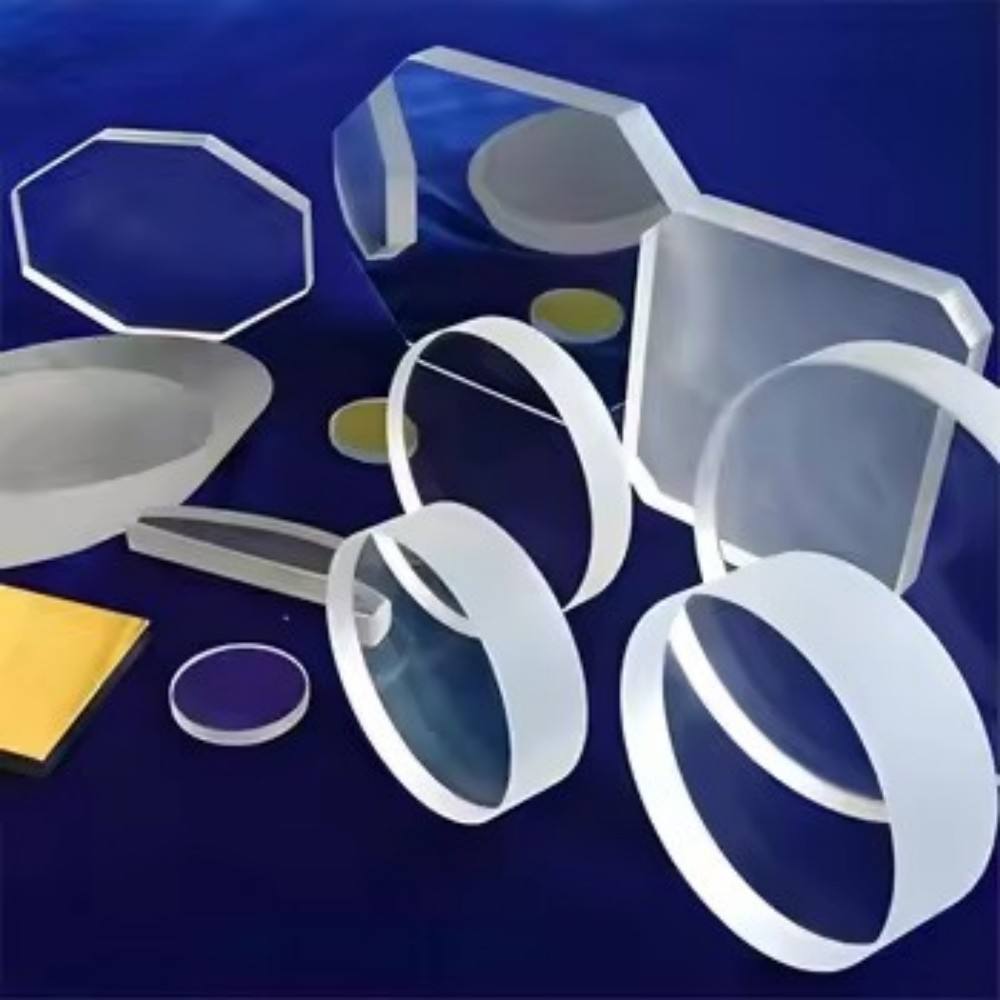
Sapphire Hard optics
0.15–5.5 µmExtremely hard, chemically resistant windows for high-pressure, high-temperature and ROV applications.
Retains strength at high temperature; built for aggressive environments.
Request this material
Undoped YAG Hard optics
0.25–5 µmNon-birefringent UV/IR windows and laser substrates with high damage threshold and thermal stability.
No absorption in the 2–3 µm water band; sapphire-like stability without birefringence.
Request this material
TGG Laser crystal
0.4–1.1 µmLarge Verdet constant and high damage threshold for Faraday rotators and optical isolators.
Excludes 470–500 nm; used in YAG, Ti:sapphire and ring lasers.
Request this material
a-BBO Polarizer
0.189–3.5 µmUV-transparent polarizing crystal for Glan polarizers and walk-off beam splitters.
Centrosymmetric — not for nonlinear frequency conversion.
Request this material
YVO₄ Polarizer
0.4–5 µmLarge-birefringence, non-hygroscopic crystal for fiber isolators, circulators and beam displacers.
Common 1310/1550 nm fiber-optic polarization material; calcite alternative.
Request this materialFour questions, one right material
Start from the operating band and environment. If you are unsure, send the requirement and our engineers will specify it.
Tell us the material and the spec
Send your drawing, target wavelength band and quantity. Our engineers review the requirement and review the project and confirm the next steps.
- Helpful details: material, wavelength, diameter/thickness, coating and quantity
- You can attach a drawing, datasheet or sketch with your request
- Prototype and production orders both welcome