Sapphire Optical Grades & Spectral Transmittance – Full Grade Classification Guide
Semiconductor and aerospace industries put forward the highest requirements for material purity and stability. High-purity sapphire with Al₂O₃ purity ≥99.99% is widely used in these two fields. This article elaborates its purity indicators, defect standards and application requirements.
2. What Is High-Purity Sapphire
High-purity sapphire refers to single crystal sapphire with raw material purity above 99.99%. It strictly controls metal ion impurities, internal inclusions, bubbles and dislocations, to avoid pollution and performance attenuation in ultra-clean and harsh working environments.
3. Key Purity & Technical Standard
| Grade | Main Features | Transmittance Range | Typical Usage |
|---|---|---|---|
| Industrial Optical Grade | Minor tiny defects, economical | 220nm ~ 4.5μm | Ordinary monitoring windows, general industrial optics |
| Standard Optical Grade | Zero visible defects, stable transmittance | 200nm ~ 5μm | Conventional optical instruments, medical parts |
| Laser Grade | Ultra-low internal absorption, high uniformity | Full design band | Laser protective windows, laser lenses |
| Aerospace Grade | Highest purity & defect-free | 200nm ~ 5μm | UAV domes, military optical systems |
4. Manufacturing Process
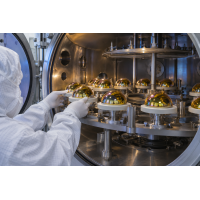
High-grade optical sapphire adopts high-purity raw materials and strict crystal growth. After cutting, multiple fine grinding and ultra-precision polishing are carried out, plus spectral testing one by one to screen qualified products. Higher grades require longer production and stricter inspection.
5. Core Advantages by Grade
- Industrial Optical Grade: Balance performance and cost for ordinary optical scenarios
- Standard Optical Grade: Stable comprehensive performance, mainstream choice for civilian high-end optics
- Laser Grade: Low light absorption, resist laser radiation, long service life
- Aerospace Grade: Extreme stability, adapt to high altitude, temperature difference and harsh environment
6. Spectral Transmittance Features
- Near UV (200~300nm): Transmittance gradually rises; sapphire is not suitable for deep UV below 200nm
- Visible light band: High and stable transmittance, no color difference
- Mid-infrared (1~5μm): Excellent transmittance, core advantage of sapphire in IR field
7. Grade Selection Guide
- Deep UV below 200nm: Not recommended to use sapphire, select quartz glass
- Conventional visible & near UV: Standard optical grade
- Laser equipment: Special laser grade
- Military, aerospace and high-precision imaging: Aerospace grade
8. FAQ
Q1: What optical bands can sapphire transmit?
A1: Mainly 200nm to 5μm, covering near ultraviolet, visible light and mid-infrared.
Q2: Which grade is used for laser equipment?
A2: Professional laser grade sapphire is required.
Q3: Can sapphire be used for deep UV below 200nm?
A3: No. Its transmittance drops sharply in deep UV band.
Q4: What is the highest grade of sapphire?
A4: Aerospace high-precision grade with the strictest defect control.
9. Conclusion
Sapphire optical grades and transmittance determine its applicable scenarios. Select matching grade according to optical band and equipment precision to optimize effect and control cost.
👉 Related Knowledge & Products: Single Crystal Sapphire vs Polycrystalline Sapphire | Sapphire Windows | Sapphire Domes
Author: Felix Glass Optical Engineering Team
Reviewed By: Senior Optical Material Engineer
Last Updated: June 2026
References: Optical Sapphire Grading Standard, UV-IR Optical Material Manual