What Is Sapphire Crystal? Composition, Properties & Industrial Applications
What Is Sapphire Crystal
Industrial synthetic sapphire is artificially grown single crystal α-Al₂O₃ with purity up to 99.99% and above. It does not belong to glass, ceramic or traditional gem materials. Its ordered crystal structure brings stable isotropic performance.
Main classification by structure:
- Single crystal sapphire: Uniform optical & mechanical performance, for high-precision optical components
- Polycrystalline sapphire: Lower cost, for general heat-resistant and protective parts
1. Key Properties
| Performance Index | Technical Data
Main Composition | ≥99.99% Aluminum Oxide (Al₂O₃) |
| Mohs Hardness | 9 (Second only to diamond) |
| Continuous Working Temperature | Up to 1600°C |
| Thermal Expansion Coefficient | Low, excellent dimensional stability |
| Spectral Transmittance | 200nm ~ 5μm (Near UV to Mid-IR) |
| Chemical Resistance | Resist most acids, alkalis & organic solvents |
| Mechanical Feature | High strength, scratch-proof, brittle under strong impact
2. Manufacturing Process
Production flow: High-purity alumina raw material preparation → High-temperature crystal growth → Orientation cutting → Rough grinding → Precision polishing → Defect inspection → Finishing. Strict temperature and environment control ensure crystal integrity and performance consistency.
3. Core Advantages
- Ultra-high hardness: Excellent scratch and wear resistance for long-term outdoor & harsh environment use
- Extreme heat resistance: Stable operation at 1600°C, far exceeding quartz glass and ordinary glass
- Wide-spectrum transmission: Cover near ultraviolet, visible light and mid-infrared bands
- Superior chemical stability: Resist most corrosive media at room and moderate high temperature
- High structural strength: Withstand air pressure, water pressure and mechanical load
4. Application Scenarios
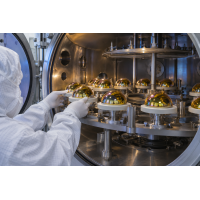
- Aerospace & Defense: Optical domes, observation windows, protective lenses
- Optical & Laser Industry: Laser protective windows, optical substrates, lens elements
- Medical Devices: Endoscope windows, surgical instrument accessories, detection lenses
- Semiconductor: Wafer carrier, high-temperature process fixtures
- Industrial Equipment: High-temperature viewing windows, wear-resistant protective covers
5. Material Comparison (Sapphire vs Ordinary Glass)
Ordinary glass has low hardness, poor heat resistance and narrow transmission range. Sapphire single crystal owns comprehensive advantages in mechanical strength, temperature resistance and optical performance. For high-end industrial and optical scenarios, sapphire is the preferred solution.
6. FAQ
Q1: What is the main chemical composition of sapphire crystal?
A1: Industrial synthetic sapphire is mainly composed of high-purity aluminum oxide (Al₂O₃).
Q2: Is industrial sapphire the same as gemstone sapphire?
A2: They have the same chemical composition, but industrial sapphire is colorless synthetic single crystal for functional use.
Q3: What is the hardness grade of sapphire?
A3: It reaches 9 on the Mohs hardness scale, only softer than diamond.
Q4: Can sapphire work under long-term high temperature?
A4: Yes, its maximum continuous working temperature is up to 1600°C.
7. Conclusion
Sapphire crystal stands out among advanced optical and structural materials relying on excellent comprehensive performance. It is widely adopted in high-end industries with strict requirements on hardness, temperature resistance and optical quality.
👉 Related Knowledge & Products: Sapphire Glass vs Quartz Glass | Single Crystal Sapphire vs Polycrystalline Sapphire | Sapphire Windows & Domes
Author: Felix Glass Optical Engineering Team
Reviewed By: Senior Optical Material Engineer
Last Updated: June 2026
References: ISO 12123 Optical Glass Standards, Aerospace Sapphire Specification