Sapphire vs Borosilicate Glass | Hardness & Temperature Guide
Sapphire vs Borosilicate Glass: Hardness, Temperature & Chemical Resistance
Overview
Sapphire (single-crystal alumina) and borosilicate glass are two widely used transparent materials for industrial, laboratory and high-temperature applications. While borosilicate glass is the standard choice for general labware and low-to-medium temperature equipment, sapphire delivers extreme hardness, ultra-high temperature resistance and superior chemical stability, making it the preferred material for harsh industrial environments.
This guide provides a full comparison of their mechanical, thermal, optical and chemical properties, helping engineers and procurement teams select the right material for their application.
Reviewed by: Senior Optical & Materials Engineer
Last Updated: June 2026
1. Core Property Comparison
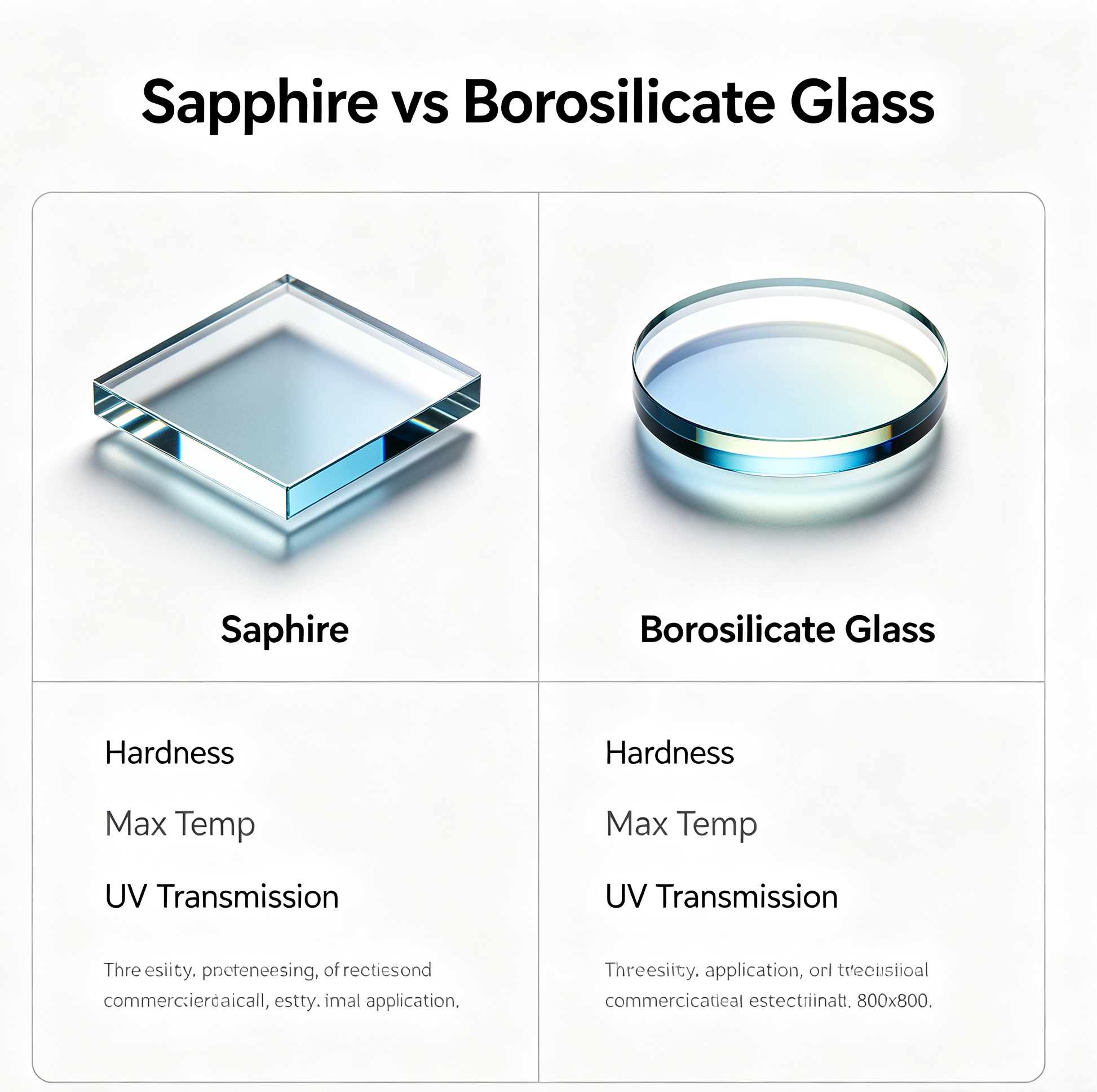
| Parameter | Sapphire (Al₂O₃) | Borosilicate Glass |
|---|---|---|
| Mohs Hardness | 9 (second only to diamond) | ~6 |
| Max Continuous Temperature | 1600°C | 450°C |
| Thermal Expansion | 5.8×10⁻⁶ /°C | 33×10⁻⁷ /°C |
| Thermal Shock Resistance | Good | Moderate |
| Transmission Range | 150 nm – 5.5 μm | 300 nm – 2.5 μm |
| UV Transparency | Excellent (down to 150 nm) | Poor (blocks below 300 nm) |
| Chemical Resistance | Excellent (resists most acids/alkalis) | Good (acid-resistant, weak against strong alkalis) |
| Mechanical Strength | Ultra-high tensile/compressive strength | Moderate strength, brittle under impact |
| Relative Cost | Premium | Economical |
Key Takeaway: Sapphire completely outperforms borosilicate glass in hardness, temperature resistance, UV transparency and long-term durability, but at a higher cost. Borosilicate remains the most cost-effective choice for standard laboratory and low-temperature applications.
2. Optical & Spectral Performance
Sapphire
- Ultra-wide transmission range from vacuum UV (150 nm) to mid-infrared (5.5 μm), supporting multi-band optical systems.
- Maintains consistent transmittance even after long-term UV exposure, with no yellowing or degradation.
- Suitable for UV, visible and IR optical windows, lenses and prisms.
Borosilicate Glass
- Poor UV transmission, cannot be used for UV sterilization, curing or spectroscopy.
- Only stable in visible and near-infrared bands, limited to general observation and lighting applications.
3. Thermal & Mechanical Properties
Sapphire
- Continuous operating temperature up to 1600°C, suitable for ultra-high-temperature furnaces and process chambers.
- Mohs 9 hardness provides exceptional scratch and wear resistance, ideal for pressure-bearing and friction-prone components.
- Excellent structural stability under high pressure and mechanical stress.
Borosilicate Glass
- Maximum continuous temperature limited to 450°C, prone to cracking under rapid temperature changes.
- Moderate hardness, easily scratched in industrial environments, leading to reduced light transmission and service life.
4. Typical Application Scenarios
Choose Sapphire If You Need:
- High-temperature process equipment above 450°C
- Wear-resistant windows, sight glasses and mechanical friction components
- UV, visible and IR multi-band optical systems
- Harsh chemical environments with strong acids/alkalis
- Long-lifetime components in aerospace, defense and semiconductor equipment
Choose Borosilicate Glass If You Need:
- Standard laboratory glassware (beakers, flasks, test tubes)
- Low-to-medium temperature observation windows without UV requirements
- Cost-sensitive industrial components for general-purpose use
5. Common Selection Mistakes & Solutions
Mistake 1: Using borosilicate for high-temperature applications
Problem: Thermal cracking and component failure under temperatures above 450°C.
Solution: Upgrade to sapphire for temperatures exceeding 450°C.
Mistake 2: Using borosilicate for UV optical systems
Problem: Complete UV blockage and equipment inefficiency.
Solution: Replace with sapphire or quartz glass for all UV applications.
Related Articles
- Sapphire vs Quartz Glass: Hardness, Temperature & Optics
- Sapphire Optical Grades & Spectral Transmittance
- Sapphire Window Manufacturing Process Guide
Related Products
- Sapphire Windows & Domes
- Borosilicate Glass Components
- Industrial High-Temperature Optical Parts
Get a Custom Quote
Share your working temperature, spectral requirements and application environment. Our team will recommend the optimal material and provide a custom solution.