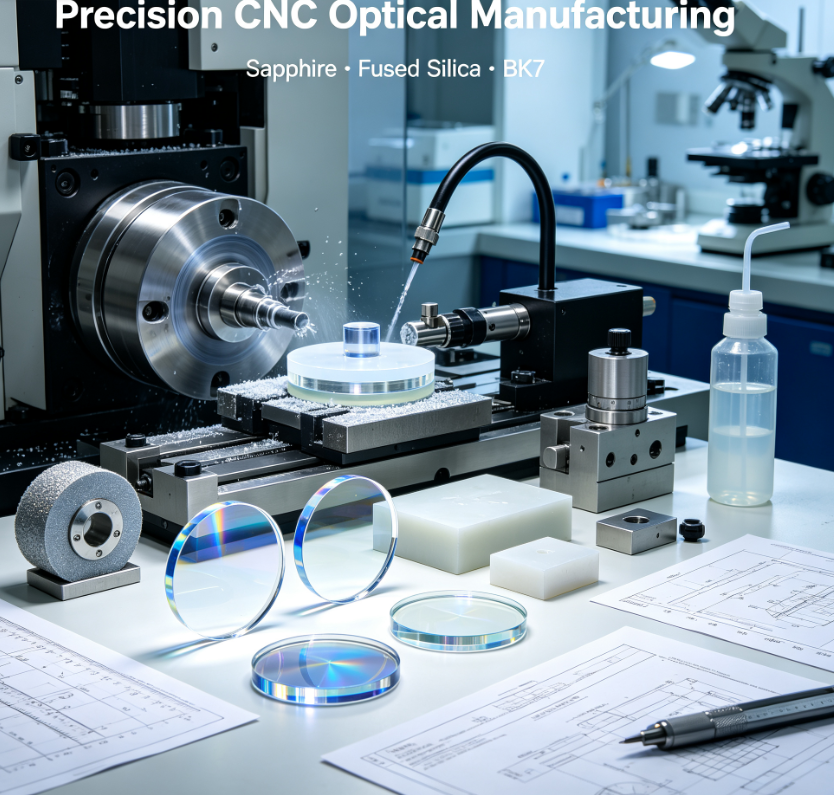
Precision CNC Optical Manufacturing
Custom CNC Machining for Sapphire, Fused Silica and BK7 Optical Glass Components
Felix Glass provides full-process CNC custom machining of sapphire, fused silica, and BK7 optical glass components for industrial equipment manufacturers, laboratory instrument builders, medical device OEMs, and aerospace optical system integrators. From material selection and precision grinding to final polishing and application-specific optical coating, each component is produced to your exact drawing, tolerance specification, and surface quality requirement, with consistent repeatability across small-batch and prototype quantities.
CNC Custom Optical Glass Machining for Precision Equipment Builders
When your optical equipment design requires a custom machined glass component that off-the-shelf optics cannot satisfy, CNC machining provides the geometric flexibility, dimensional accuracy, and surface finish control needed for integration-ready parts. Felix Glass supports the full fabrication chain from raw optical blank to finished component.
For Optical Design Engineers
Specify your exact material grade, geometry, dimensional tolerance, and surface quality. Receive CNC-machined optical components that match your Zemax or Code V design parameters without compromise, supported by interferometric test data and material certifications.
For Custom Equipment Mechanical Designers
Integrate optical glass components into your mechanical assemblies with confidence. Each part is machined to your CAD model with tight edge profiling, mounting features, and interface geometries that fit directly into your equipment housing without secondary modification.
For OEM Optical Component Procurement
Source custom optical parts with repeatable quality across production batches. Fixed pricing for defined quantities, documented quality control records, and flexible delivery scheduling aligned to your equipment manufacturing timeline.
Optical Glass Material Selection for CNC Machining
Material choice determines the optical transmission range, mechanical strength, thermal behavior, and chemical resistance of your finished component. Felix Glass CNC-machines three primary optical glass families, each suited to different wavelength bands and operating environments.
Sapphire Optical Glass
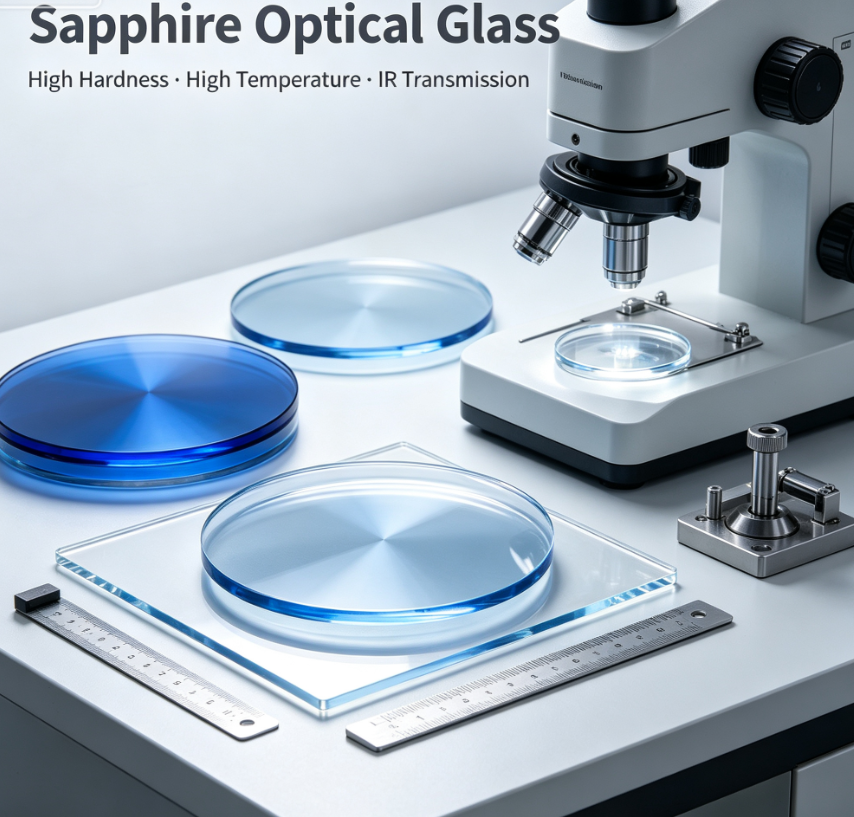
Single crystal sapphire delivers the highest hardness (Mohs 9), exceptional transmission from 0.17 um to 5.5 um, and thermal stability to 2030 degrees C. This makes it the preferred substrate for high-temperature viewports, IR sensor windows, and scratch-resistant optical interfaces in harsh industrial and defense environments.
- Transmission: 0.17 um to 5.5 um
- Knoop Hardness: 2,000 kg/mm squared parallel to c-axis
- Max Operating Temperature: 2,030 degrees C
- Surface Quality: 10-5 scratch-dig achievable
Fused Silica Optical Glass
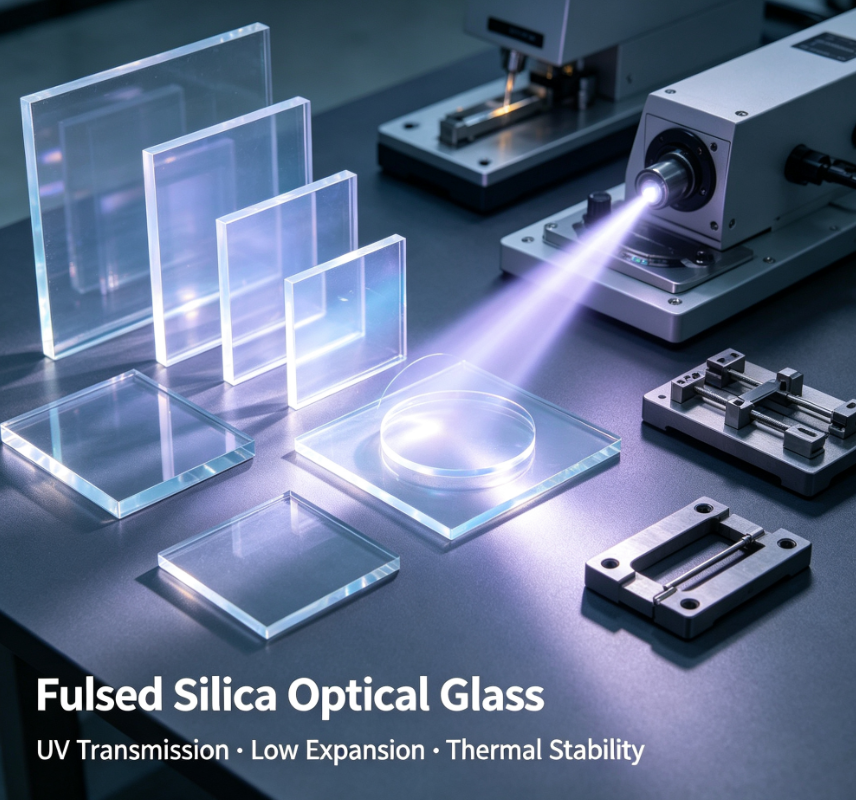
UV-grade fused silica provides outstanding deep-UV transmission from 185 nm, near-zero thermal expansion (CTE 0.55 x 10 to the negative 6 per K), and excellent laser damage resistance. This makes it the substrate of choice for UV spectroscopy windows, excimer laser optics, and interferometric reference flats used in precision measurement instruments.
- Transmission: 185 nm to 2.1 um
- CTE: 0.55 x 10 to the negative 6 per K
- Surface Accuracy: Lambda/10 PV at 633 nm
- Available Grades: JGS1, JGS2, Corning 7980
BK7 Optical Glass
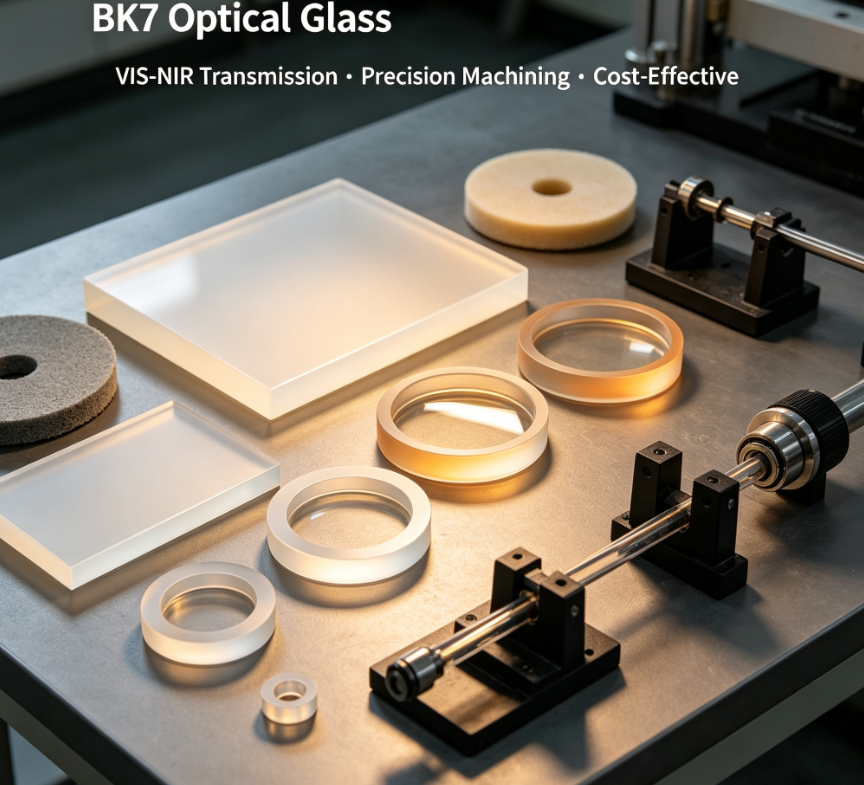
BK7 borosilicate crown glass delivers excellent transmission across the visible and near-IR spectrum (350 nm to 2 um), high homogeneity, and cost-effective processability. This makes it the standard substrate for visible-wavelength laser optics, imaging system windows, beam splitter substrates, and general-purpose optical components where controlled cost is a design requirement.
- Transmission: 350 nm to 2 um
- Refractive Index: n sub d equals 1.5168
- Abbe Number: 64.17
- Density: 2.51 g per cm cubed
CNC Machining Capabilities for Optical Glass Components
Felix Glass operates CNC machining centers configured for brittle optical materials, with diamond tooling, controlled coolant delivery, and in-process metrology. Each capability below is available as a standalone service or as part of a complete fabrication package.
CNC Contouring and Shaping
Precision edge profiling, beveling, step cutting, and complex perimeter shaping of optical blanks to exact drawing dimensions. Handles rectangular, circular, elliptical, and custom polygonal geometries with tight edge quality.
CNC Drilling and Hole Patterning
Precision through-hole and blind-hole drilling in optical glass components, including mounting hole patterns, locating pin holes, and clearance bores with controlled edge chipping below 0.2 mm for sapphire and fused silica substrates.
CNC Slot and Pocket Machining
Internal slot, pocket, and recess machining in optical glass for sensor integration, gasket seating, and mechanical interlock features. Depth control to plus/minus 0.01 mm on sapphire and BK7 substrates.
Precision Dicing and Singulation
High-accuracy dicing of larger optical blanks into individual components with consistent edge quality. Supports array singulation for multi-cavity optical assemblies and wafer-scale optical component production.
CNC Polishing and Surface Finishing
Multi-stage CNC polishing from coarse lapping to optical-grade finish. Achieves surface roughness Ra below 5 nm, flatness to Lambda/10, and scratch-dig specifications of 10-5 or 20-10 on sapphire, fused silica, and BK7 substrates.
In-Process Optical Metrology
Laser interferometer surface profiling, non-contact 3D optical profilometry, and coordinate measurement at each machining stage. Full inspection reports included with every production batch shipment.
Precision Tolerances and Quality Specifications
Each CNC-machined optical component from Felix Glass is produced to your specified tolerance class, verified through documented inspection at every processing stage.
Linear dimension control on sapphire and BK7 substrates for critical fit applications
Transmitted wavefront accuracy at 633 nm for interferometric and imaging applications
Scratch-dig specification per MIL-PRF-13830B for laser and precision imaging optics
Ultra-smooth polished surface finish for low-scatter optical applications
Industrial Equipment Optical Components
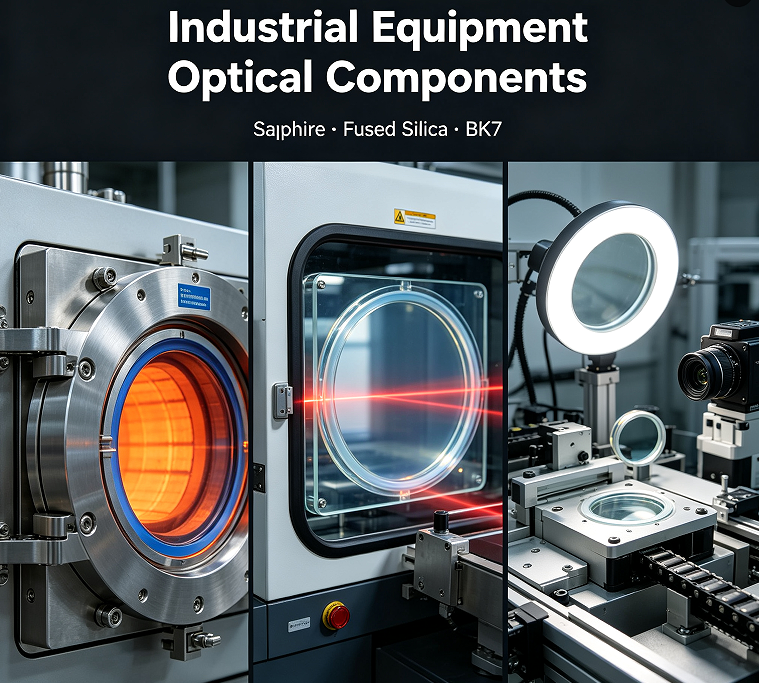
Industrial processing equipment requires optical glass components that maintain performance under continuous operation, thermal cycling, and exposure to process chemicals. Felix Glass CNC-machines sapphire viewports for furnace monitoring, fused silica windows for laser processing enclosures, and BK7 inspection windows for machine vision systems.
- Sapphire furnace observation windows withstand continuous exposure to 1,000 degrees C plus
- CNC-profiled fused silica laser protection windows with damage threshold above 10 J per cm squared
- BK7 machine vision windows with broadband AR coating for 400 to 700 nm
- Custom mounting flange integration with O-ring groove machining
Medical Device and Laboratory Optical Components
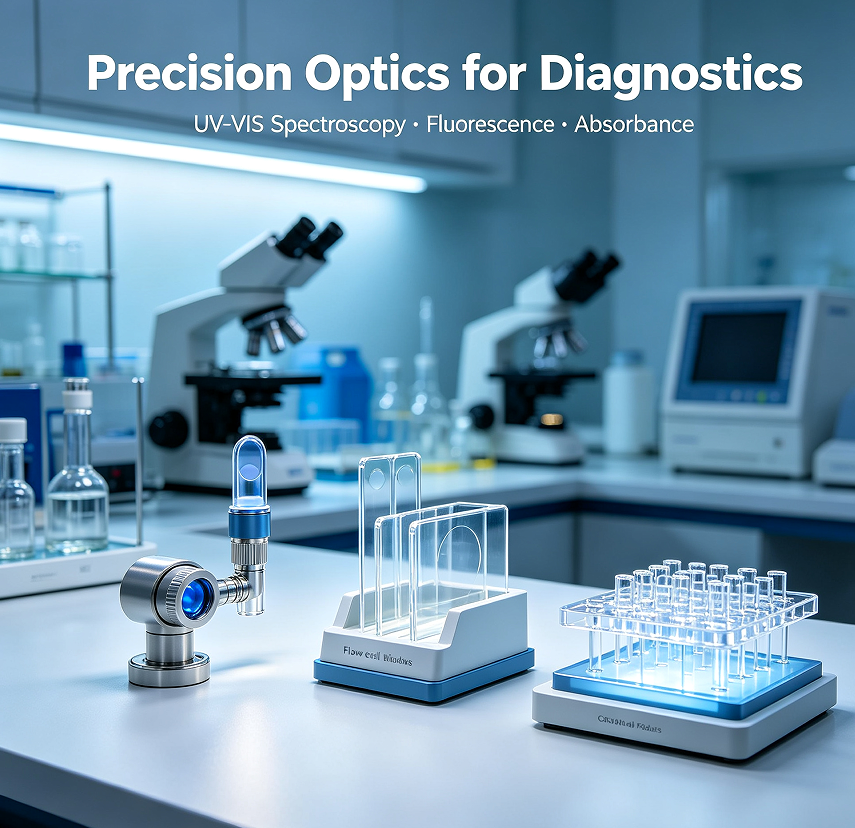
Medical diagnostic instruments, analytical laboratory equipment, and clinical sensor systems rely on precision optical windows and components that combine optical clarity with biocompatibility and chemical resistance. Felix Glass supplies CNC-machined sapphire and fused silica optical components for these regulated applications.
- Sapphire sensor windows for in-vivo and ex-vivo diagnostic devices
- Fused silica cuvette blanks and flow-cell windows for UV-VIS spectroscopy
- CNC-drilled multi-well optical plates for fluorescence and absorbance readers
- Full material traceability and sterilization compatibility documentation
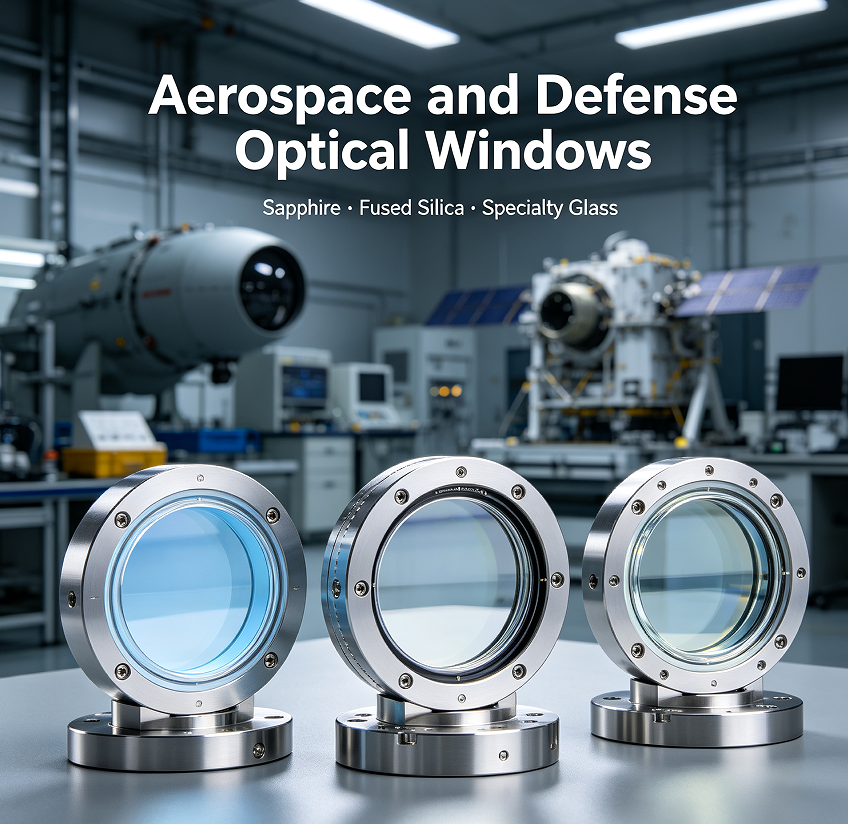
Aerospace and Defense Optical Windows
Aerospace electro-optical and infrared sensor systems require optical windows that maintain transmission accuracy across wide temperature ranges while surviving vibration, pressure differential, and particle impact environments. Felix Glass CNC-machines sapphire, fused silica, and specialty optical glass windows qualified for airborne, space-based, and ground defense applications.
- Sapphire EO/IR sensor windows with broadband AR coating from 0.5 to 5 um
- Fused silica laser rangefinder windows with high LIDT coating
- CNC-profiled mounting flanges with controlled parallelism to 10 arc seconds
- Environmental qualification test reports available per MIL-STD-810
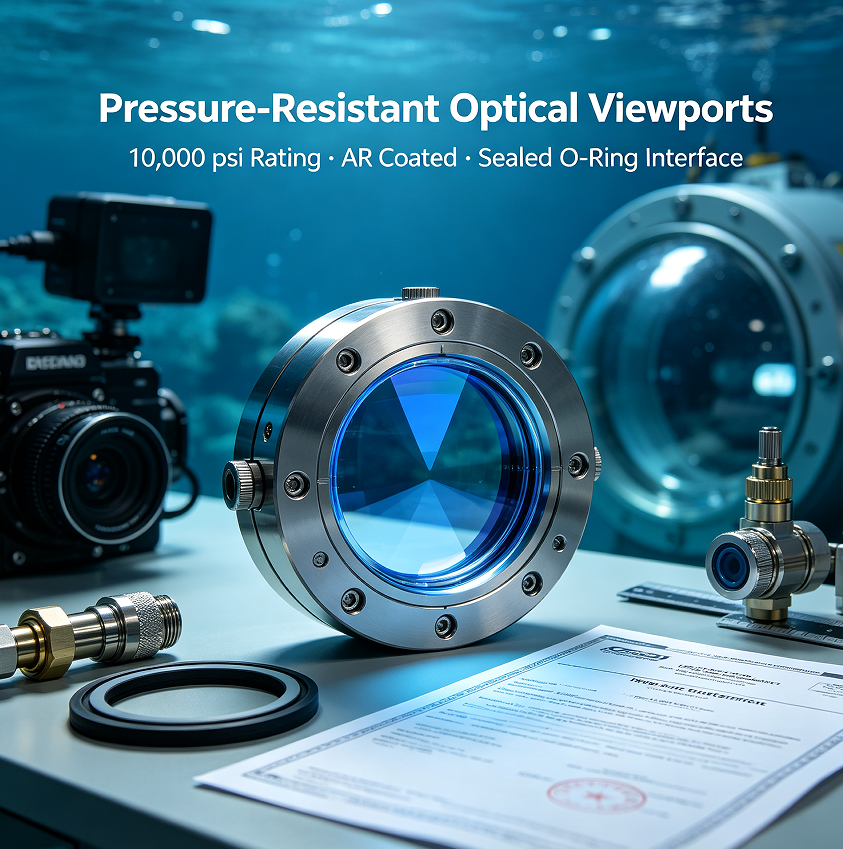
Underwater Detection Optical Viewport Windows
Subsea optical sensor systems, underwater cameras, and marine detection equipment require pressure-resistant optical viewports that maintain clarity and structural integrity at depth. Felix Glass CNC-machines sapphire and toughened optical glass windows engineered for hydrostatic pressure environments.
- Sapphire viewport windows with pressure rating exceeding 10,000 psi
- CNC-profiled conical seat geometry for pressure-sealing O-ring interfaces
- Anti-reflective coating optimized for underwater visible wavelength transmission
- Hydrostatic pressure test certification available per application requirement
Why Choose Felix Glass for Custom CNC Optical Manufacturing
When you source custom CNC optical glass components from Felix Glass, you work with a manufacturer that understands both the optical performance requirements and the mechanical integration constraints of your equipment design.
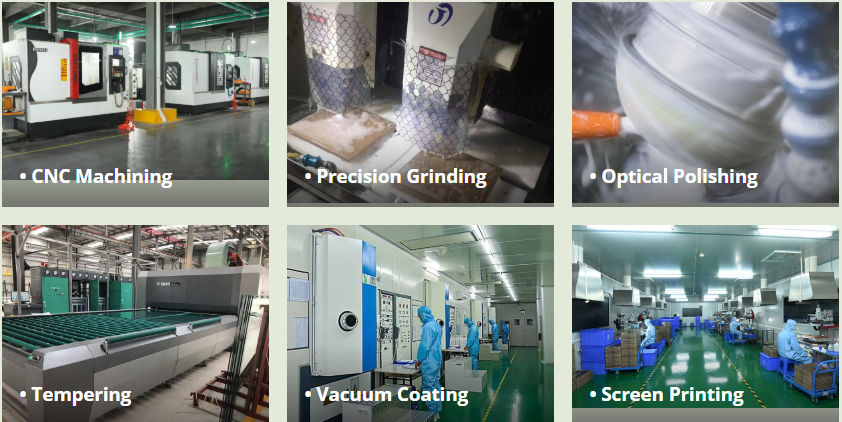
Full-Process In-House Manufacturing
From raw optical blank inspection to final coated component, every process step is performed in-house at our facility. This eliminates the coordination risk, lead-time variability, and quality inconsistency that occur when multiple subcontractors handle different stages of your component.
Drawing-to-Part Service
Send your CAD file or technical drawing and receive a finished optical component. No intermediate steps, no translation errors
Small-Batch OEM Delivery
Prototype quantities of 1 to 50 pieces with the same process control as production volumes
Full Inspection Documentation
Interferometric surface data, dimensional reports, and coating transmission spectra with every shipment
Engineering Collaboration
Direct technical communication with our optical fabrication engineers during design review and process development
Optical Coating and Surface Treatment Services
After CNC machining and polishing, optical coatings are applied to achieve the transmission, reflection, or environmental protection performance your application requires. Felix Glass offers the following coating services applied to your machined optical components.
Broadband Anti-Reflective Coating
Single-layer and multi-layer AR coatings optimized for UV (190 to 400 nm), visible (400 to 700 nm), near-IR (700 to 2,500 nm), and mid-IR (3 to 5 um) bands. Average reflectance below 0.5 percent per surface across the design band.
Hard Protective Overcoat
Diamond-like carbon and durable dielectric overcoat layers applied to sapphire and fused silica components for scratch resistance, chemical protection, and extended service life in abrasive or chemically active environments.
Bandpass and Dichroic Filter Coating
Custom wavelength-selective coatings for fluorescence filter applications, multispectral sensor windows, and laser line separation in optical instrument designs. Edge steepness and out-of-band blocking specified to your requirements.
Hydrophobic and Oleophobic Coating
Water and oil repellent topcoat with contact angle above 110 degrees, applied as a final layer over AR or protective coatings for medical devices, outdoor sensor windows, and touchscreen optical interfaces.
CNC Machining vs Traditional Optical Fabrication
Understanding how CNC machining compares to conventional optical grinding and polishing helps you choose the right fabrication approach for your component requirements.
- Direct CAD-to-part workflow
- Complex non-circular geometries
- Integrated mounting features
- Consistent batch repeatability
- Short setup for prototype quantities
- Combined shaping and polishing
- Established for spherical optics
- High-volume plano optics cost efficiency
- Standardized tooling available
- Limited non-circular geometry capability
- Higher setup cost for low quantities
- Secondary operations for mechanical features
For custom optical components with non-standard geometries, integrated mechanical features, or prototype quantities, CNC machining typically offers shorter lead time, lower tooling cost, and direct CAD-to-part traceability compared to traditional fabrication methods.
Custom CNC Optical Component Project Workflow
From initial inquiry to final delivery, each custom CNC optical component project follows a structured process designed to align technical specifications, manufacturing parameters, and quality verification with your equipment integration requirements.
Design Review and Feasibility Assessment
Our optical fabrication engineers review your CAD model or technical drawing against material properties, machining capability, and coating compatibility. We identify any design-for-manufacturing considerations and provide a feasibility report with recommendations.
Process Development and Quotation
We define the machining sequence, tooling selection, polishing stages, and coating specification for your component. A fixed-price quotation is provided with lead time, minimum order quantity, and per-unit pricing for your review.
Material Procurement and Incoming Inspection
Optical-grade raw material is sourced from qualified suppliers with full material certification. Each blank undergoes incoming dimensional and optical inspection before release to the CNC machining cell.
CNC Machining and In-Process Metrology
Multi-axis CNC machining with diamond tooling, controlled coolant, and programmed feed rates optimized for the selected optical glass. In-process dimensional checks at each machining stage using CMM and laser interferometry.
Polishing, Coating and Final Inspection
Multi-stage polishing to specified surface quality, followed by optical coating deposition. Final inspection includes surface profilometry, transmission spectrophotometry, environmental testing per specification, and visual inspection.
Packaging, Documentation and Delivery
Each component is packaged in cleanroom-grade protective packaging with individual inspection reports, material certifications, coating spectra, and batch traceability documentation included in the shipment.
Small-Batch OEM Prototype and Production Service
For optical equipment manufacturers developing new instruments or transitioning from prototype to production, Felix Glass provides small-batch CNC optical component fabrication with the process control and documentation required for OEM supply chains.
Prototype Fabrication
Single-piece to 10-piece prototype runs for design validation and proof-of-concept testing. Engineering feedback on manufacturability and suggestions for production optimization included.
Pre-Production Qualification
First article inspection and process qualification runs of 10 to 50 pieces to validate manufacturing repeatability before scaling to production volumes.
Production Supply
Recurring batch production with fixed pricing, scheduled deliveries, and ongoing process monitoring to maintain consistent quality across production lots.
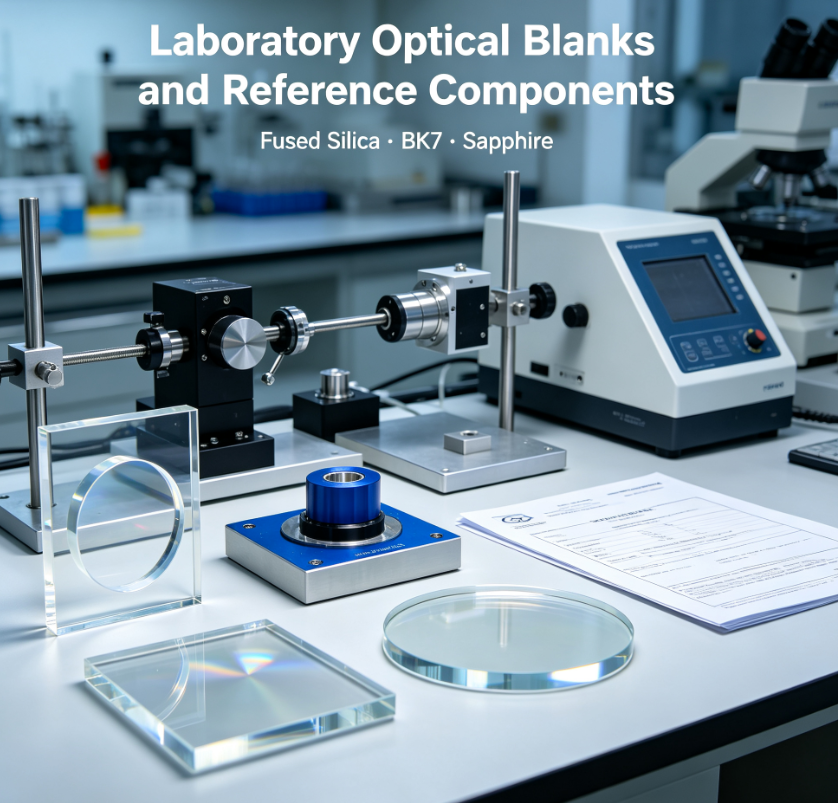
Laboratory Optical Blanks and Reference Components
University research groups, national laboratories, and analytical instrument manufacturers require optical blanks and reference windows fabricated to exacting flatness, parallelism, and surface quality specifications for calibration, interferometry, and spectroscopy applications. Felix Glass supplies CNC-machined optical blanks in sapphire, fused silica, and BK7 matched to your research-grade requirements.
- Fused silica reference flats with Lambda/20 surface accuracy for interferometric calibration
- BK7 spectrophotometer calibration windows with certified transmission data
- Sapphire high-temperature sample holders for thermal analysis instruments
- Custom dimensions from 5 mm to 300 mm diameter or diagonal
Frequently Asked Questions About Custom CNC Optical Glass Machining
What optical glass materials can you CNC machine?
We CNC machine three primary optical glass families: single crystal sapphire (Al2O3), UV-grade fused silica (SiO2), and BK7 borosilicate crown glass. Sapphire provides the highest hardness and thermal stability for demanding industrial and defense applications. Fused silica offers superior UV transmission and near-zero thermal expansion for spectroscopy and laser optics. BK7 is the standard choice for visible-wavelength laser and imaging components where cost efficiency is important. Each material is available in multiple grades with full material certification.
What is the minimum order quantity for custom CNC optical components?
We accept orders from a single prototype piece. For production quantities, typical minimum order quantities are 10 to 50 pieces depending on component complexity. Prototype pricing is provided on a per-unit basis, and production pricing is structured with volume-tier discounts. For OEM programs with recurring delivery schedules, we offer fixed annual pricing with scheduled batch releases.
What surface quality and flatness can you achieve through CNC polishing?
Our multi-stage CNC polishing process achieves surface roughness Ra below 5 nm, transmitted wavefront accuracy of Lambda/10 PV at 633 nm, and scratch-dig specifications of 10-5 per MIL-PRF-13830B on sapphire, fused silica, and BK7 substrates. The achievable specification depends on material type, component geometry, and aspect ratio. During design review, we confirm the realistic surface quality for your specific part configuration.
What is the typical lead time for custom CNC optical components?
Standard lead time for prototype quantities is 15 to 25 working days from order confirmation and drawing approval. Production quantities typically require 25 to 40 working days for the first batch, with subsequent batches at 15 to 25 working days. Lead time varies with material availability, component complexity, coating specification, and current production queue. Expedited service is available for time-critical projects with a confirmed delivery date commitment.
Do you provide inspection data and material certifications with each order?
Every shipment includes a comprehensive inspection documentation package with interferometric surface profile data, dimensional measurement reports, optical transmission spectra for coated components, material certificates of conformance from our raw material suppliers, and batch traceability records. For OEM production programs, we maintain a quality data history accessible for your supplier quality audits.
Start Your Custom CNC Optical Component Project
Send your CAD drawing, technical specification, or application description. Our optical fabrication engineering team will review your requirements and provide a feasibility assessment and quotation within 2 working days.