EO/IR Protective Optics
Multi-Band Sapphire Protective Windows for EO/IR Surveillance, Targeting and Aerospace Electro-Optical Systems
Scratch-resistant sapphire protective windows with dual-band AR coatings, engineered for thermal imaging, night vision, and multi-spectral sensor packages deployed on airborne, ground-based, and naval platforms. Custom CNC-machined geometries with verified MIL-SPEC environmental durability for US defense and aerospace equipment manufacturers.
The Critical Role of Protective Windows in EO/IR System Performance
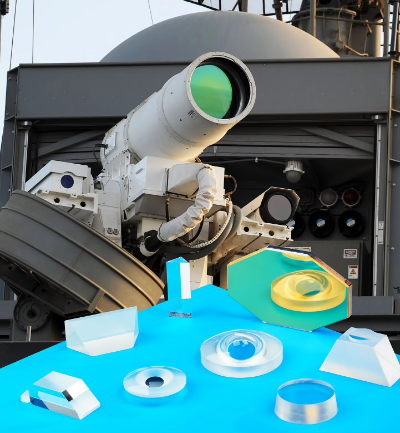
Electro-optical and infrared sensor systems deployed on military platforms face severe environmental threats that directly degrade mission capability. The protective window is the primary optical interface between the sensor and the operational environment, and its material properties determine the system's effective range, image clarity, and survivability.
Environmental Attack on Optical Surfaces
High-velocity sand, dust, rain erosion, and salt spray at operational altitudes and speeds progressively degrade unprotected optical surfaces. Standard optical glasses lose 15-30% transmission within 200 flight hours due to pitting and surface roughening. EO/IR sensor windows require materials with hardness exceeding Mohs 8 to maintain optical performance across service lifetimes.
Thermal Gradients and Shock Loading
Supersonic platforms and high-power sensor packages generate rapid temperature transitions exceeding 200°C per second. Window materials that cannot withstand these gradients crack, delaminate coatings, or introduce refractive index distortions that degrade MTF (Modulation Transfer Function) across the sensor field of view.
Multi-Spectral Transmission Requirements
Modern fused EO/IR systems operate simultaneously across visible, SWIR (1-3 μm), MWIR (3-5 μm), and LWIR (8-12 μm) bands. Window materials must maintain high internal transmittance across all operational wavebands while supporting broadband or dual-band anti-reflective coatings that do not introduce spectral artifacts into sensor processing chains.
Sapphire: The Material Standard for EO/IR Protective Windows
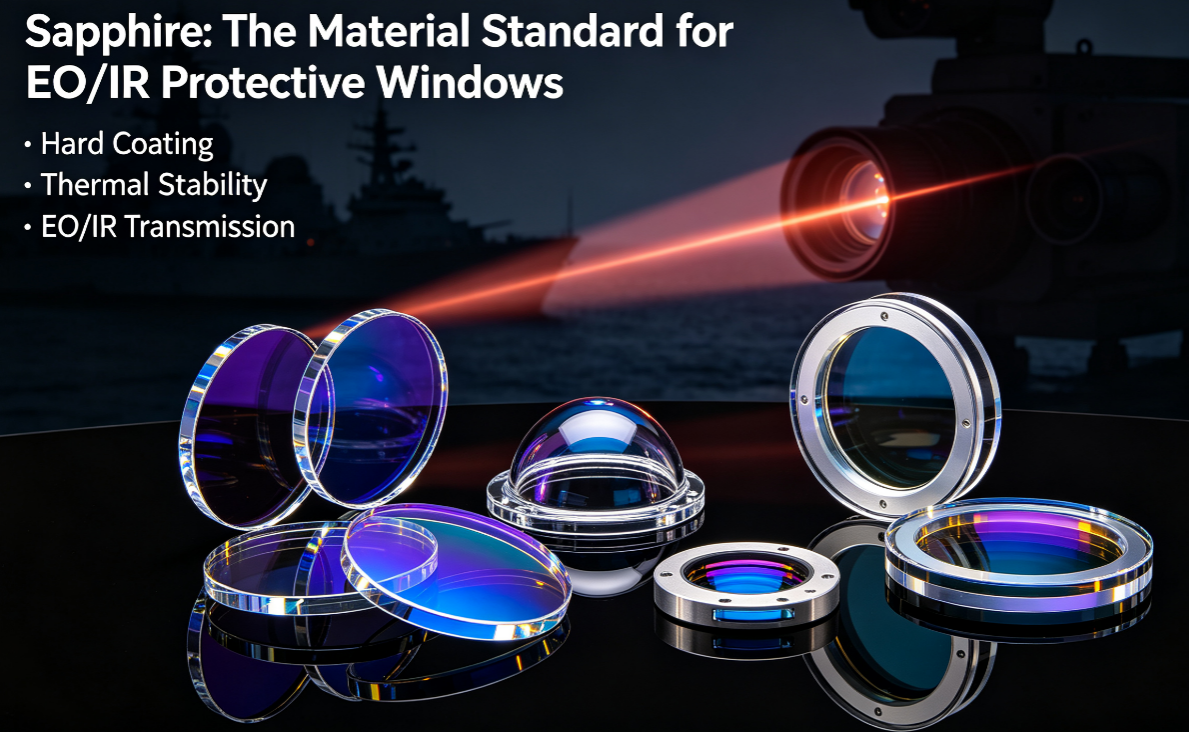
Synthetic sapphire (single-crystal aluminum oxide, Al2O3) delivers the optimal combination of mechanical durability and broadband optical transmission demanded by military-grade EO/IR protective windows. Unlike polycrystalline ceramics or glass-ceramic alternatives, single-crystal sapphire exhibits zero grain-boundary scattering, ensuring diffraction-limited optical quality across the full sensor aperture.
- Mohs 9 hardness: second only to diamond, resistant to sand, rain, and particle impact erosion
- Broadband transmission from 150 nm UV through 5.5 μm MWIR with >85% internal transmittance
- Thermal conductivity of 35 W/m·K: 5× higher than BK7 glass, enabling rapid thermal equilibration
- Melting point of 2,053°C: withstands aerodynamic heating and high-energy sensor environments
- Chemical inertness: unaffected by aviation fuels, hydraulic fluids, de-icing agents, and salt spray
- Zero-birefringence c-axis orientation available for polarization-sensitive sensor payloads
Multi-Band Optical Transmission: UV Through MWIR Performance
EO/IR sensor suites on platforms such as MQ-9 Reaper, F-35 EOTS, and naval MK 46 optical sight systems operate across four discrete spectral bands simultaneously. The protective window must maintain consistent internal transmittance across all bands without introducing spectral vignetting that could reduce target detection range.
UV Band (150-400 nm)
Solar-blind UV detection for missile launch warning and hostile fire indication. Sapphire maintains >80% transmittance in the UV-C and UV-B regions where most optical glasses are opaque.
VIS-NIR Band (400-1000 nm)
Daylight imaging, low-light CCD/CMOS sensors, and laser rangefinder compatibility at 905 nm and 1,064 nm. Internal transmittance exceeds 86% across the full visible spectrum.
SWIR Band (1-3 μm)
Night vision, haze penetration, and laser designation at 1.55 μm eye-safe wavelengths. Sapphire exhibits flat transmission curves with no water absorption bands in this region.
MWIR Band (3-5 μm)
Primary thermal imaging band for cooled InSb and MCT detectors. Sapphire provides >82% transmittance at 4 μm, enabling maximum thermal sensitivity for target acquisition at extended ranges.
Dual-Band Anti-Reflective Coating Technology
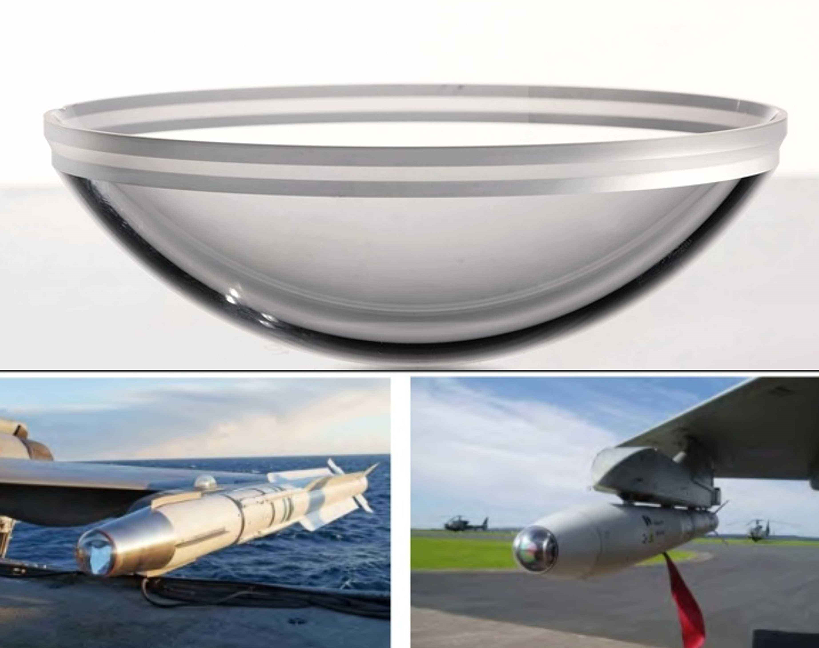
Uncoated sapphire reflects approximately 14% of incident light per surface due to its refractive index of 1.77. For a protective window with two air-glass interfaces, this represents a 26% transmission loss that directly reduces sensor signal-to-noise ratio. Felix Glass applies proprietary dual-band AR coatings optimized for the VIS-MWIR spectral range (500 nm - 5 μm) to achieve per-surface reflectance below 0.5% across both bands.
- Ion-beam assisted deposition (IBAD) for coating density approaching bulk material values
- VIS band (500-800 nm): Ravg < 0.5%, Rmax < 1.0%
- MWIR band (3.7-4.8 μm): Ravg < 0.5%, Rmax < 1.0%
- Coating adhesion certified per MIL-C-48497A humidity, abrasion, and temperature cycling tests
- Optional hydrophobic overcoat for water-shedding performance in maritime and all-weather deployments
Thermal Shock Resistance for Extreme Operational Environments
EO/IR protective windows on fast-jet platforms and missile seekers experience thermal loading beyond the capability of most optical materials. Sapphire's unique combination of high thermal conductivity, low thermal expansion, and exceptional mechanical strength at elevated temperatures enables reliable operation where alternative materials fail.
| Property | Sapphire (Al2O3) | ZnS (Multispectral) | Spinel (MgAl2O4) | BK7 Glass |
|---|---|---|---|---|
| Thermal Conductivity (W/m·K) | 35.0 | 17.0 | 14.7 | 1.1 |
| CTE (10-6/°C) | 5.3 | 7.4 | 7.0 | 7.1 |
| Thermal Shock Parameter (W/m) | 4,900 | 1,200 | 1,300 | 90 |
| Max Service Temperature (°C) | 1,800 | 600 | 1,200 | 500 |
Thermal shock parameter calculated as σf(1-ν)k/αE, where higher values indicate greater resistance to thermal fracture. Sapphire outperforms all common EO/IR window materials by a factor of 3-50×.
Precision CNC Machining for Complex Window Geometries
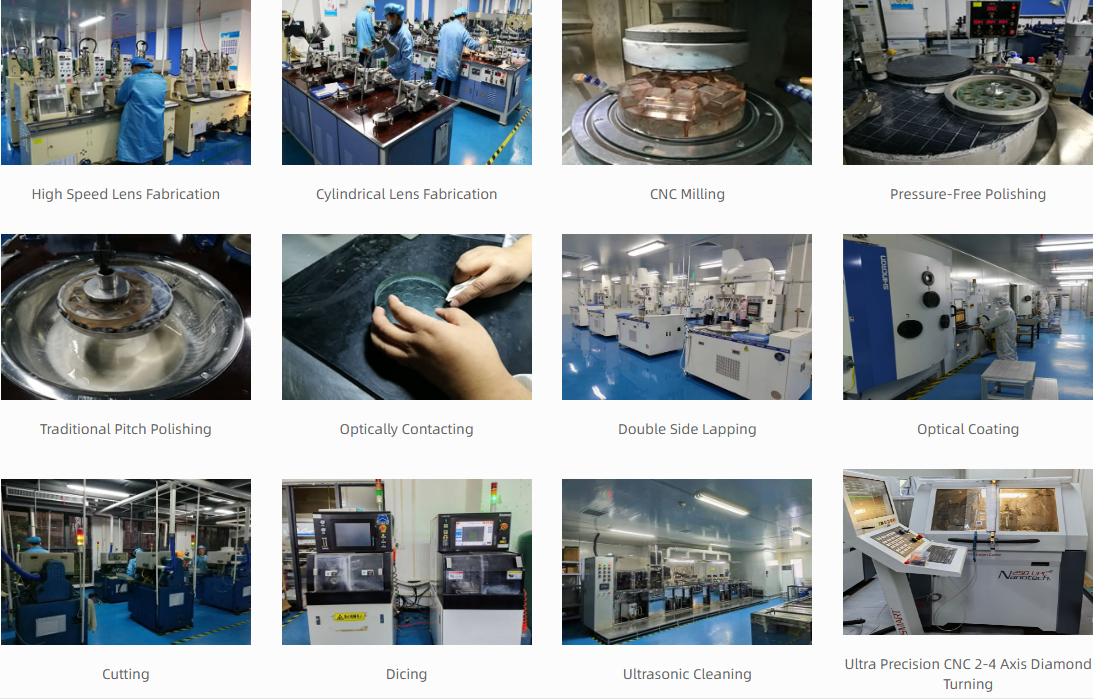
EO/IR protective windows frequently require non-circular apertures, stepped edges, mounting flanges, and integrated alignment features that cannot be produced through conventional optical grinding alone. Felix Glass operates multi-axis CNC machining centers configured for sapphire processing, enabling direct fabrication of complex geometries from solid boule material.
Rectangular & Polygonal Windows
Custom rectangular, hexagonal, and irregular apertures for conformal sensor installations. Edge chamfer and corner radius controlled to ±0.05 mm.
Stepped & Flanged Profiles
Integrated mounting flanges with O-ring grooves machined directly into the sapphire substrate. Eliminates separate metal mounting rings and reduces assembly part count.
Curved & Spherical Windows
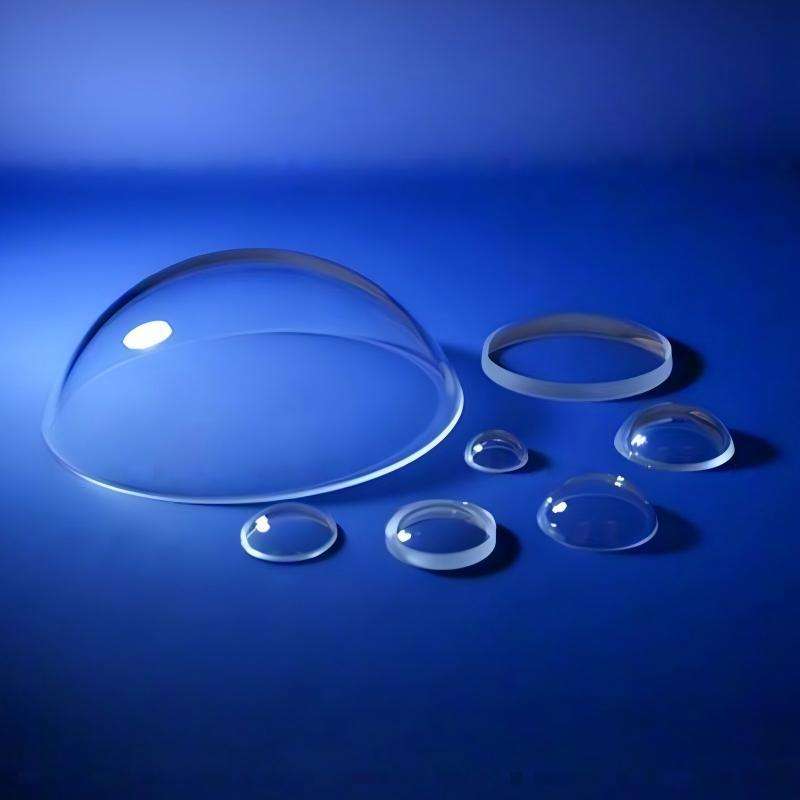
CNC-generated spherical and aspheric surfaces with subsequent precision polishing to λ/4 surface accuracy for aerodynamic conformal window applications.
Multi-Aperture Arrays
Monolithic sapphire plates with multiple precision-machined apertures for multi-sensor EO/IR turrets, eliminating inter-sensor alignment drift between discrete window components.
Surface Quality, Figure Accuracy and Optical Specifications
EO/IR sensor windows for targeting and fire-control systems impose stringent requirements on transmitted wavefront quality. Surface figure errors, subsurface damage, and mid-spatial frequency roughness all contribute to degradation of the system Modulation Transfer Function.
Surface Figure
λ/4 to λ/10 at 633 nm across clear aperture, verified by laser interferometry with full-aperture reference flat
Surface Roughness
Ra < 1 nm typical, measured by white-light interferometry or AFM per ISO 4287
Scratch-Dig
60-40 standard, 40-20 and 20-10 available for high-energy laser and sensitive detector applications per MIL-PRF-13830B
Parallelism
< 10 arc seconds standard, < 2 arc seconds available for coherent detection and interferometric sensor systems
Airborne ISR Platform Sensor Window Integration
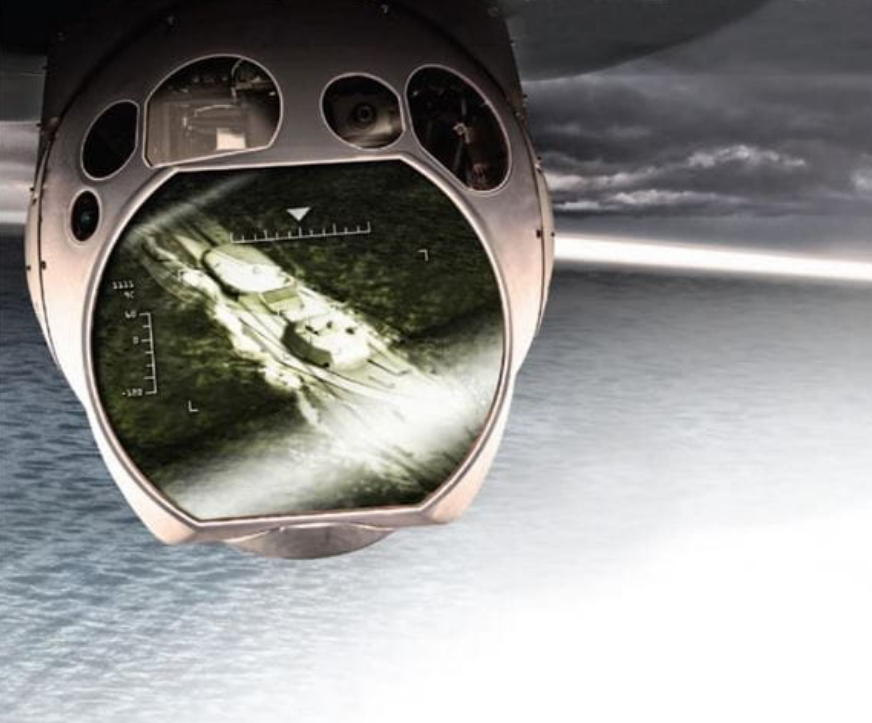
Airborne intelligence, surveillance, and reconnaissance (ISR) platforms depend on multi-spectral EO/IR turrets operating at altitudes from sea level to 50,000 feet. The protective window must withstand aerodynamic pressure loading, rapid altitude-induced temperature cycling, and continuous exposure to particulate erosion while maintaining diffraction-limited optical quality across multiple sensor apertures within a single turret assembly.
Felix Glass supplies sapphire protective windows for airborne EO/IR turret systems including MX-series, WESCAM, and BRITE Star II configurations. Each window is supplied with full interferometric qualification data, coating witness samples, and lot-traceable material certification documentation supporting platform airworthiness requirements.
View airborne-qualified sapphire window configurationsGround-Based Thermal Surveillance and Target Acquisition
Ground-based EO/IR systems including LRAS3, JANUS, and vehicle-mounted CROWS sensor suites operate in direct contact with battlefield contaminants including sand, mud, carbon residue, and chemical agents. Sapphire protective windows provide the surface hardness necessary to withstand repeated field cleaning without optical degradation, while the material's chemical inertness prevents attack from decontamination solutions and environmental agents.
For vehicle-mounted applications, Felix Glass supplies sapphire windows with edge-bonded mounting frames designed for MIL-STD-810G vibration profiles. Custom EMI/RFI grid patterns can be deposited on the window surface for electromagnetic compatibility requirements without compromising the optical aperture.
Discuss ground EO/IR window requirements with engineeringMaritime and Naval EO/IR Sensor Protection
Shipboard EO/IR systems on MK 46 optical sight systems, SeaFLIR, and naval fire-control directors face a uniquely aggressive combination of salt spray, high humidity, and constant vibration. The protective window material must resist saline pitting corrosion while the anti-reflective coating must maintain adhesion under 100% humidity cycling per MIL-STD-810G Method 507.6.
Felix Glass naval sapphire windows incorporate a hydrophobic overcoat on the external AR-coated surface to promote water droplet shedding, maintaining optical clarity in heavy sea spray conditions without requiring mechanical wipers that could abrade the coating surface. Windows are supplied with 316L stainless steel or titanium mounting frames qualified for shock loading per MIL-S-901D.
Sapphire vs. Alternative EO/IR Window Materials: Technical Selection Guide
Each EO/IR window material presents a distinct trade-off between optical performance, mechanical durability, thermal capability, and cost. The selection decision directly impacts system SWaP-C (Size, Weight, Power, and Cost) and mission availability rates.
Sapphire (Al2O3)
Best for high-speed airborne platforms, multi-band fused sensors, and applications requiring maximum environmental durability
- Hardness: Mohs 9 (scratch-resistant)
- Transmission: 150 nm - 5.5 μm
- Thermal shock resistance: Highest in class
- Typical aperture: up to 300 mm diameter
Clear ZnS (Multispectral)
Suitable for LWIR (8-12 μm) systems and cost-constrained ground applications with moderate environmental exposure
- Hardness: Knoop 250 (requires hard coating)
- Transmission: 400 nm - 12 μm
- Thermal shock: Moderate
- Typical aperture: up to 500 mm diameter
ALON / Spinel
Alternative for medium-durability applications; polycrystalline structure limits optical quality for diffraction-limited sensors
- Hardness: Knoop 1,650
- Transmission: 200 nm - 5.0 μm
- Thermal shock: Good
- Typical aperture: up to 450 mm diameter
Germanium (Ge)
LWIR-only systems; requires hard carbon coating for environmental protection; thermal runaway above 70°C
- Hardness: Knoop 780 (with DLC coating)
- Transmission: 2-14 μm (LWIR only)
- Thermal shock: Poor (dn/dT very high)
- Typical aperture: up to 350 mm diameter
MIL-SPEC Environmental Testing and Qualification
Every sapphire protective window lot supplied by Felix Glass for defense applications undergoes qualification testing to verify compliance with the environmental durability standards specified in the procurement documentation. Test reports are provided with each shipment as part of the Certificate of Conformance package.
Humidity Resistance
MIL-STD-810G Method 507.6: 10-day cyclic humidity exposure, 30-60°C, 95% RH. Coating adhesion and transmission verified pre- and post-test.
Sand and Dust
MIL-STD-810G Method 510.6: Silica sand and fine dust particle exposure at controlled velocities. Surface quality and transmission measured after test cycle.
Temperature Shock
MIL-STD-810G Method 503.6: Thermal cycling from -54°C to +85°C with <1 minute transition. No coating delamination or substrate fracture allowed.
Rain Erosion
MIL-STD-810G Method 506.6: High-velocity water droplet impact simulating supersonic flight through precipitation. Transmission loss <2% post-exposure.
Salt Fog Corrosion
MIL-STD-810G Method 509.6: 48-hour continuous 5% NaCl salt fog exposure at 35°C. No pitting, coating degradation, or measurable transmission loss.
Mechanical Vibration
MIL-STD-810G Method 514.7: Random vibration profiles per platform category (jet aircraft, ground vehicle, shipboard). Window integrity and mounting verified post-test.
Custom OEM Development: From Specification to Qualified Production
Felix Glass supports the full development lifecycle for custom EO/IR protective windows, from initial material selection consultation through prototype fabrication, qualification testing, and production ramp-up. Each program follows a structured engineering process designed to align with defense acquisition timelines.
Requirements Analysis
Engineering review of spectral transmission requirements, aperture dimensions, mounting interface, environmental specifications, and target unit cost. Material recommendation with trade study documentation comparing sapphire against alternative window materials.
Prototype Fabrication
CNC machining, precision polishing, and AR coating of first-article prototype windows. Full metrology qualification including interferometry, spectrophotometry, and surface profilometry data package.
Qualification Testing
Environmental testing per customer-specified MIL-STD-810G methods. Coating durability certification per MIL-C-48497A. Lot-acceptance testing protocol established for production repeatability.
Production & Delivery
Scaled production with statistical process control and First Article Inspection (FAI) per AS9102. Each production lot ships with Certificate of Conformance, interferometric data, and coating witness samples.
Quality Management and Documentation for Defense Programs
First Article Inspection
AS9102-compliant FAI reports with dimensional, optical, and material certification data for each configuration and revision.
Certificate of Conformance
Lot-specific CoC documenting material lot traceability, coating run identification, and all optical performance measurements.
Material Traceability
Full boule-to-window traceability with sapphire crystal growth lot, orientation, and post-growth annealing records maintained for 10 years.
Source Inspection
Customer or government source inspection at Felix Glass facilities prior to shipment. Government Quality Assurance (GQA) support available.
Why US Aerospace and Defense Equipment Manufacturers Partner with Felix Glass
EO/IR Materials Expertise
Dedicated sapphire processing facility with crystal orientation control, precision polishing, and IBAD coating under one quality management system. Engineering team supports material selection trade studies with measured performance data from qualified samples.
Configurable Manufacturing Scale
Production capacity scales from single prototype units to annual production quantities of 1,000+ windows. Mixed-model production lines accommodate multiple window configurations within a single manufacturing schedule.
Export-Compliant Documentation
Complete ECCN classification support, end-use statements, and export documentation packages prepared for ITAR and EAR-governed optical components. Experienced with US Department of Commerce BIS licensing requirements.
Long-Term Program Support
Configuration-managed production with revision-controlled process documentation. Sustaining engineering support available for the program lifecycle including obsolescence management, cost-reduction initiatives, and technology insertion.
Related Technical Resources for EO/IR Optical Engineers
Sapphire Optical Glass Material Data
Complete technical specifications including refractive index vs. wavelength, thermal properties, mechanical strength data, and chemical resistance tables for single-crystal sapphire.
Multi-Band Sapphire EO/IR Protective Window Product Page
Standard window configurations, coating options, mounting frame designs, and ordering specifications for off-the-shelf and custom sapphire protective windows.
Precision Instrument Calibration Optics
Reference-grade optical flats, calibration windows, and metrology substrates for interferometric verification of EO/IR sensor window figure accuracy.
Frequently Asked Questions: EO/IR Sapphire Protective Windows
What is the maximum aperture size for a single sapphire protective window?
Felix Glass currently supplies sapphire windows up to 300 mm diameter in a-axis and c-axis orientations. For larger apertures exceeding 300 mm, we offer multi-segment window assemblies with precision-aligned seams. Production capacity for 350 mm sapphire windows is under development and available for customer-funded qualification programs.
Can the dual-band AR coating withstand continuous exposure to salt spray environments?
Yes. The dual-band AR coating applied to Felix Glass sapphire EO/IR windows has been qualified to MIL-STD-810G Method 509.6 (48-hour continuous 5% NaCl salt fog at 35°C) with zero coating degradation and no measurable transmission loss. For extended maritime deployments, we recommend the optional hydrophobic overcoat for additional protection against saline residue accumulation.
What is the typical lead time for a custom EO/IR sapphire window program?
Prototype windows with standard AR coatings are typically delivered 8-12 weeks from receipt of final drawing and specification package. Production quantities follow First Article Inspection approval, generally 14-18 weeks ARO. Expedited prototype service is available at 6-8 weeks for time-critical programs.
How does sapphire c-axis orientation affect optical performance for polarization-sensitive sensors?
Sapphire is a uniaxial birefringent crystal. For polarization-sensitive EO/IR sensors such as polarimetric thermal imagers, windows are supplied in c-axis (0001) orientation where the crystal's optic axis is perpendicular to the window surface. In this orientation, normally incident light experiences zero birefringence regardless of polarization state. Off-axis birefringence effects are documented in the technical data package.
Do you supply EMI/RFI shielded sapphire windows for EO/IR systems requiring electromagnetic compatibility?
Yes. We offer deposited metallic grid patterns on the internal surface of sapphire windows for EMI/RFI shielding. Grid geometries are designed to minimize obstruction of the optical aperture while achieving shielding effectiveness of 30-50 dB depending on grid pitch and line width. The grid is deposited beneath the AR coating stack and does not affect environmental durability.
Request Engineering Consultation for Your EO/IR Protective Window Program
Share your system requirements with the Felix Glass optical engineering team. Provide the following information for a detailed technical proposal and quotation:
Window Dimensions & Geometry
Clear aperture dimensions, overall part dimensions, thickness, edge profile, chamfer requirements, and any integrated mounting features.
Spectral Requirements
Operational wavebands (UV, VIS, NIR, SWIR, MWIR, LWIR), minimum transmission thresholds, and any band-rejection requirements for laser protection.
Environmental Specifications
Applicable MIL-STD-810G test methods, platform type, operating altitude, temperature range, shock and vibration profiles.
Production Requirements
Prototype quantity and schedule, estimated annual production volume, program duration, and any export compliance considerations.