UV Grade Fused Silica Optical Glass Solutions
Felix Glass supplies low-impurity UV-transparent fused silica optical blanks, substrates, and precision windows for university spectroscopy laboratories, UV testing instrument manufacturers, and optical calibration equipment builders across North America. Every substrate is processed with controlled birefringence, verified transmission performance, and documented quality traceability to support repeatable measurement results in demanding optical systems.
Precision Substrates for Spectroscopy Applications
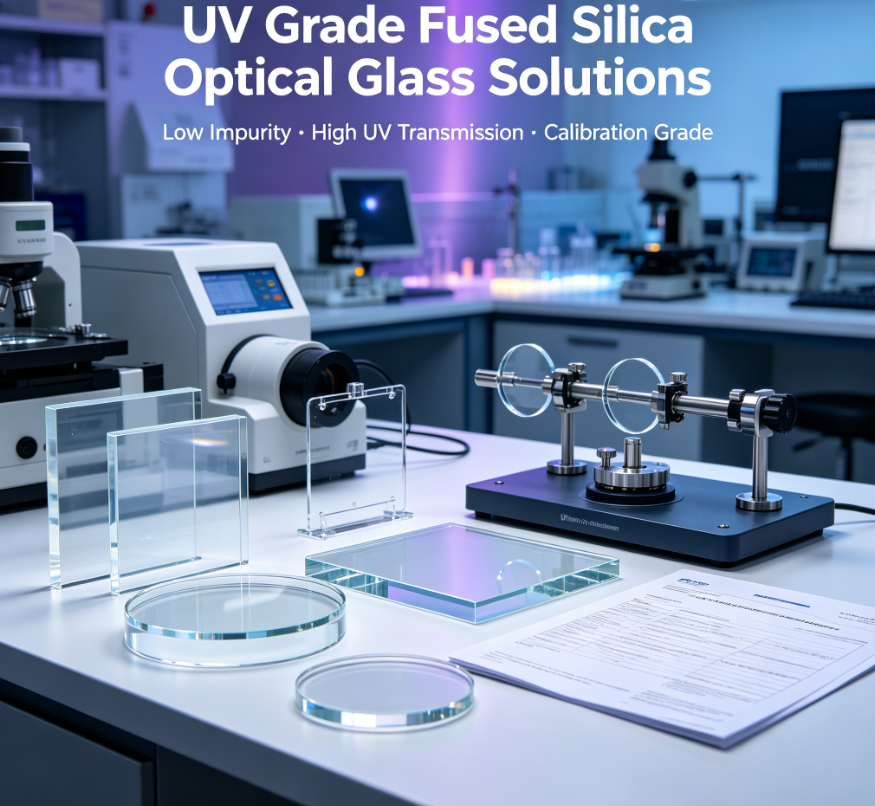
Spectroscopy demands optical materials with consistent refractive index, minimal autofluorescence, and high transmission across the UV-to-visible range. Felix Glass fused silica substrates are fabricated from synthetic silica with hydroxyl content controlled to match the target wavelength band of each instrument design.
UV-Vis Spectroscopy Windows
Flat polished windows with < 0.5 wave surface accuracy at 633 nm, suitable for cuvette-based and flow-cell UV-Vis spectrophotometer sample compartments.
Fluorescence Spectroscopy Substrates
Low-autofluorescence fused silica blanks for excitation and emission beam paths in fluorescence spectrometers and microplate readers.
Raman and FTIR Beam Splitters
Precision-thickness substrates with parallelism better than 5 arc seconds for Raman spectroscopy beam splitters and FTIR interferometer components.
Key Material Properties and Optical Specifications
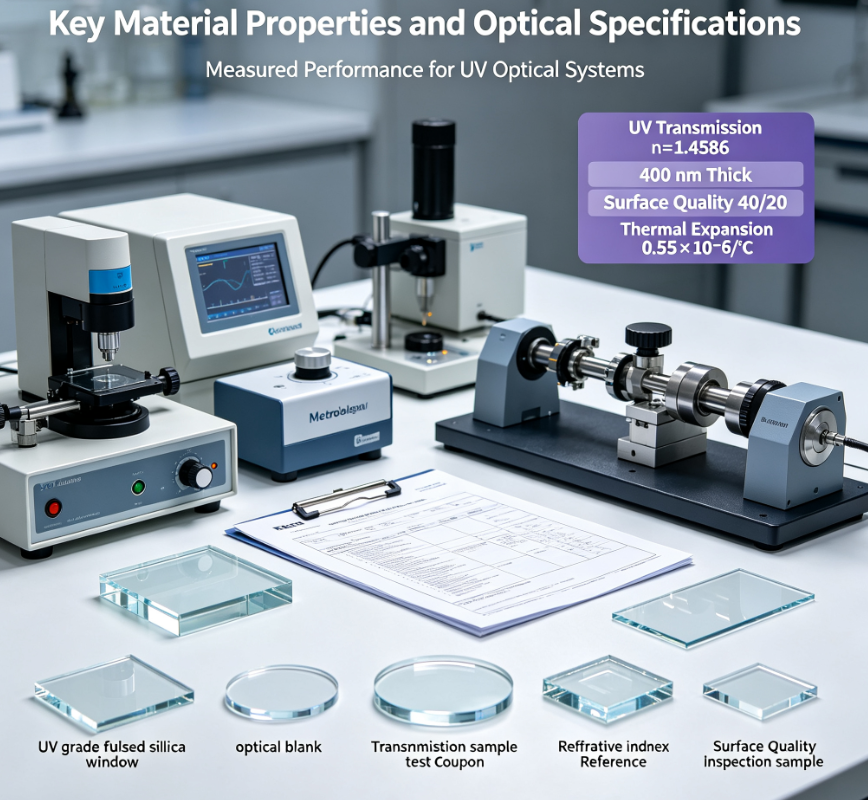
The following material characteristics define our UV grade fused silica substrates. Each lot is accompanied by a certificate of conformance listing measured values against these target specifications.
| OH Content | Controlled to match target band: low-OH (< 5 ppm) for IR-NIR, high-OH (800-1200 ppm) for deep UV |
|---|---|
| Transmission Range | 185 nm to 2.1 µm (UV grade); > 85% internal transmission at 200 nm for 10 mm thickness |
| Refractive Index | nd = 1.4585 ± 0.0005; homogeneity class H2 or better per ISO 10110 |
| Birefringence | < 4 nm/cm typical; < 2 nm/cm available on request for polarization-sensitive systems |
| Surface Quality | 40-20 scratch-dig per MIL-PRF-13830B standard; 20-10 available for laser-grade applications |
| Thermal Expansion (CTE) | 0.55 × 10⁻⁶/K (0 °C to 200 °C), maintaining dimensional stability in precision mounts |
Low Birefringence Polishing Capability
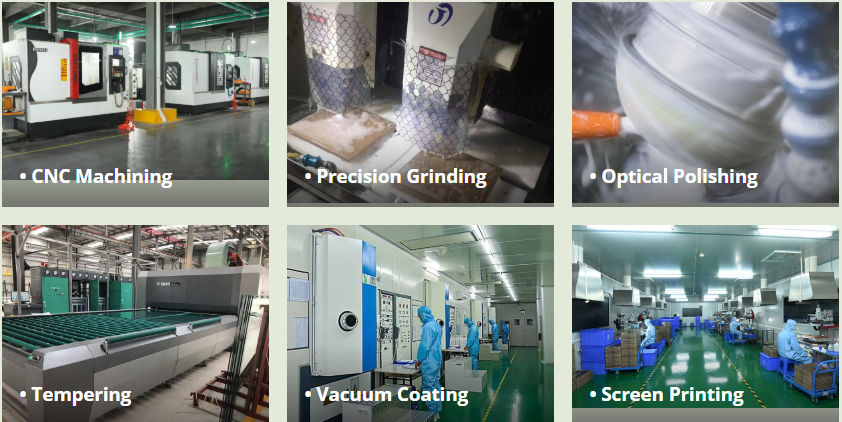
Stress-induced birefringence from aggressive polishing can compromise polarization-sensitive measurements. Felix Glass applies a multi-stage polishing protocol specifically developed for fused silica to retain the material's inherently low stress-optic coefficient.
Progressive Abrasive Sequence
Multiple grit stages from rough lapping through fine polishing minimize subsurface damage that contributes to residual stress birefringence.
Controlled Pressure Polishing
Low-force double-sided polishing maintains parallelism while limiting mechanically induced birefringence in thin substrates down to 0.3 mm thickness.
Post-Polish Stress Relief
Controlled thermal relaxation cycle after final polish reduces residual processing stress without affecting surface figure or roughness.
UV Anti-Reflective Coating Technology
Uncoated fused silica reflects approximately 7% of incident light across two surfaces. Our UV AR coatings reduce per-surface reflectance to below 0.5% across the design wavelength band, increasing system throughput for photon-starved UV measurements.
Broadband UV AR
250-450 nm band, Ravg < 1% per surface, suitable for deuterium and xenon lamp-based instruments.
Narrowband V-Coat
Single-wavelength optimized AR with R < 0.2% at laser lines including 266 nm, 355 nm, and 405 nm.
Durable Hard Oxide AR
Ion-assisted deposition hard coating for instruments requiring periodic cleaning or field-deployable spectroscopy systems.
Dual-Band AR
Simultaneous AR performance in UV and visible or UV and NIR bands for multi-detector spectrometer designs.
Small-Batch Prototype Machining Services
Instrument development programs often require small quantities of custom-shaped fused silica components before committing to production volumes. Felix Glass supports prototype-stage projects with CNC machining, core drilling, and edge profiling on fused silica blanks without minimum order quantity requirements.
Material Selection
Choose OH content, grade, and starting blank dimensions matched to your optical design requirements.
CNC Shaping
Diamond-tool machining for rectangular, circular, and custom-contour substrate outlines with 0.05 mm positional tolerance.
Edge Profiling
Ground or polished edges with bevel options, safe-edge finish, or sharp corners per your mounting fixture requirements.
Surface Finishing
Polished to your specified surface quality and flatness, with optional coating applied before final inspection.
Applications in UV Testing Instruments
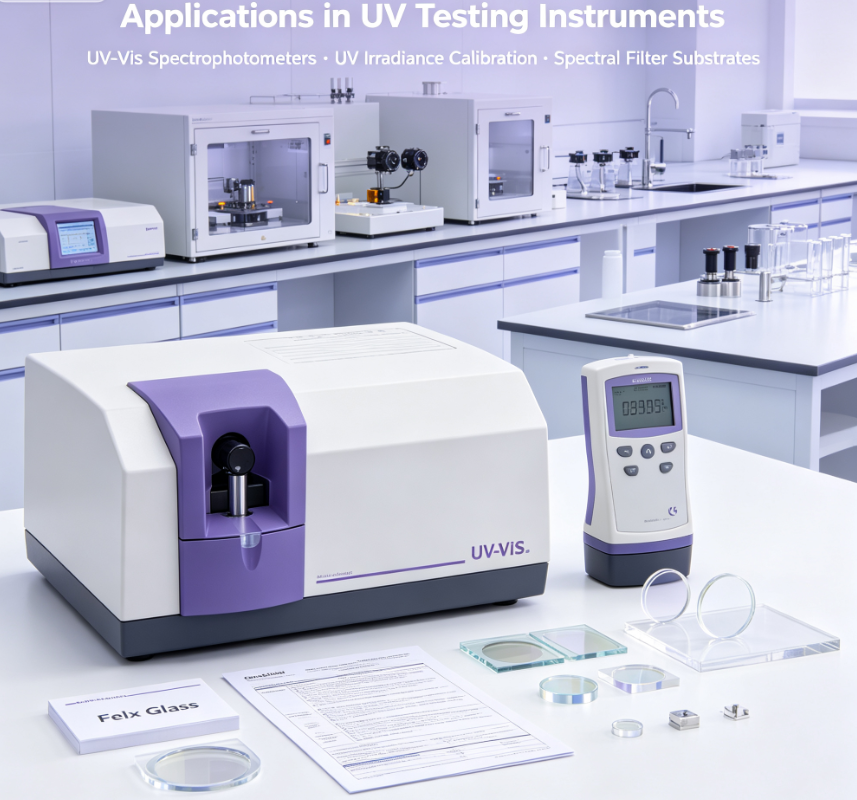
Our fused silica optical components are integrated into UV measurement instruments across academic research laboratories and commercial testing equipment. Each application places different demands on transmission, scatter, and surface precision.
UV-Vis Spectrophotometers
Beam splitter windows, reference cuvette windows, and sample compartment optics for double-beam UV-Vis instruments used in quantitative analysis and kinetics measurement.
UV Irradiance Calibration
Transmissive diffuser plates and attenuation windows for spectral irradiance calibration standards traceable to NIST reference detectors.
Spectral Filter Substrates
Planar substrates for UV bandpass, long-pass, and neutral-density filter deposition used in monochromator-based measurement systems.
Laboratory Optical Blank and Window Solutions
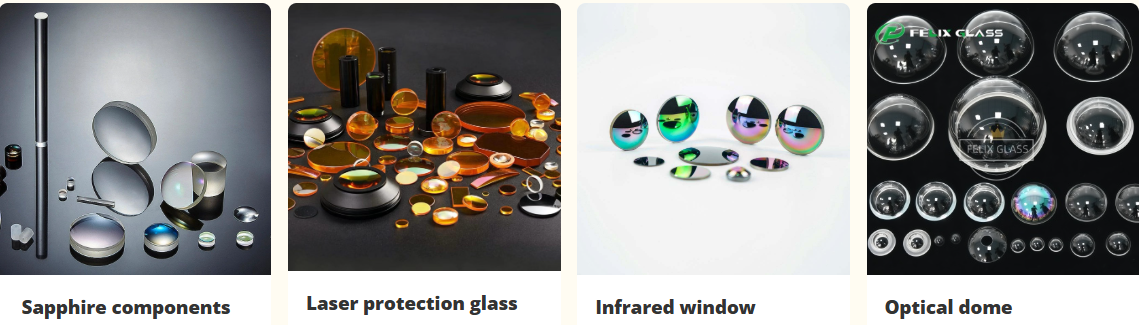
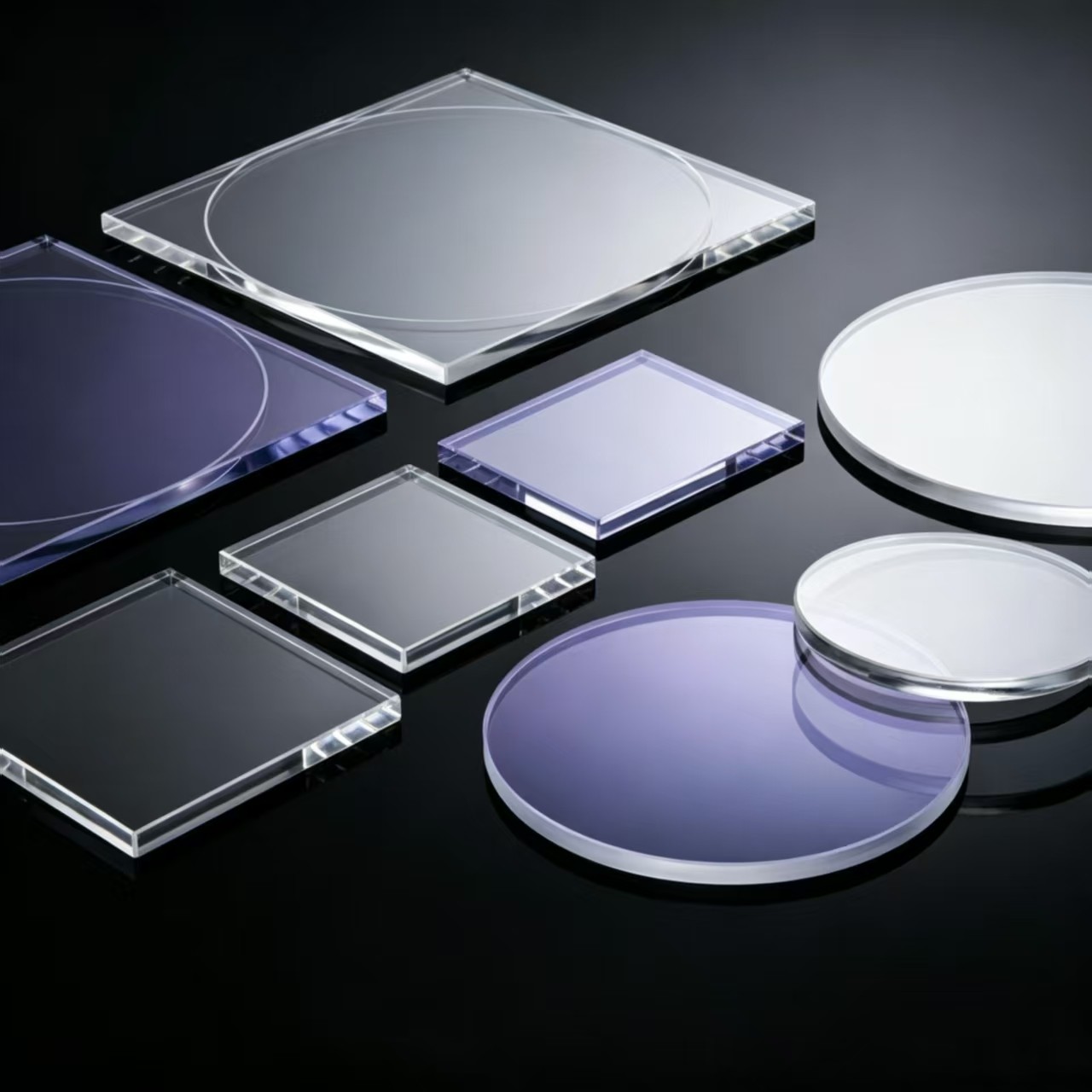
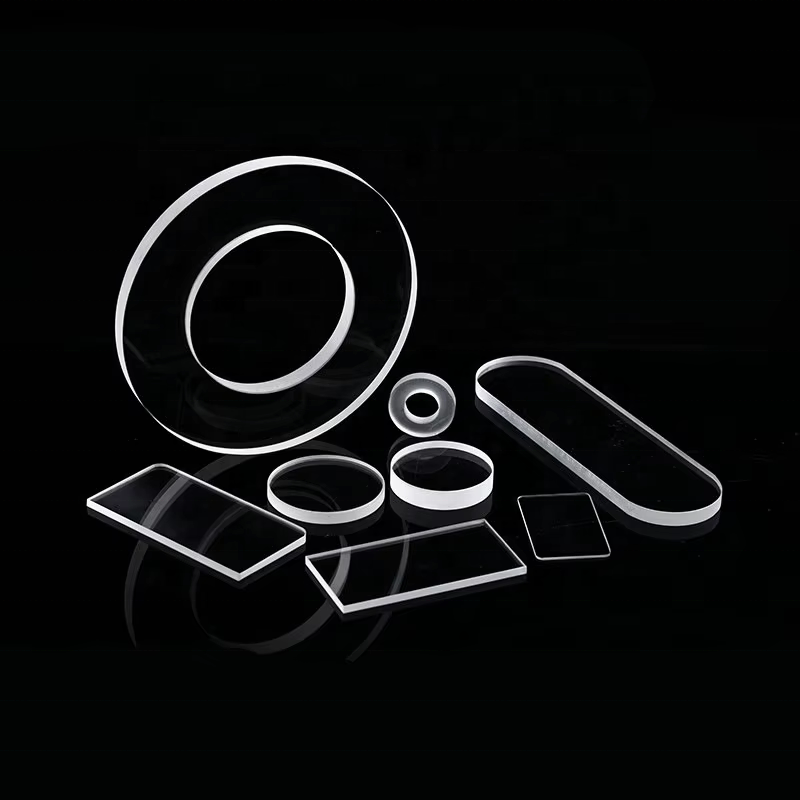
University laboratories and research instrument builders rely on our fused silica blanks and windows for custom optical setups that demand high UV transmission, low wavefront distortion, and consistent batch-to-batch quality.
Quality Control and Inspection Standards
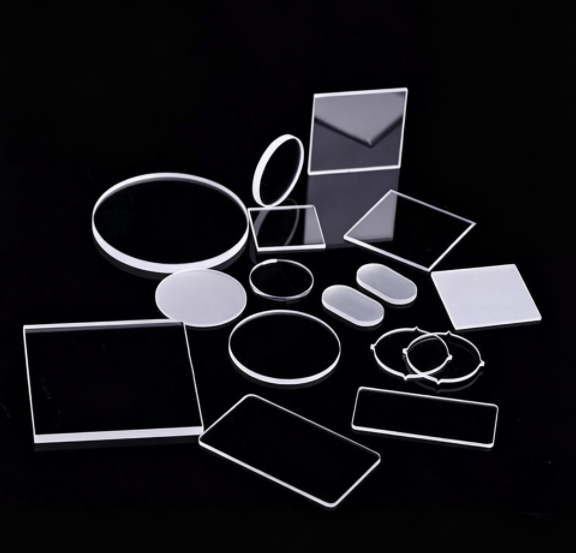
Every fused silica substrate shipped from Felix Glass passes through a documented inspection workflow. Spectroscopy optical engineers and lab procurement managers receive a detailed inspection report with each order, eliminating the need for incoming inspection at the receiving facility.
Interferometric Flatness
Zygo Verifire laser interferometer measurement at 632.8 nm, reported as PV and RMS wavefront error with 2D surface map.
Surface Quality Inspection
Visual inspection per MIL-PRF-13830B under controlled illumination, with digital microscopy documentation for critical surfaces.
Spectral Transmission Scan
UV-Vis-NIR spectrophotometer transmission trace from 185 nm to 2.5 µm included with each coated substrate lot.
Parallelism Verification
Autocollimator measurement of wedge angle and parallelism, recorded to 1 arc second resolution for each window shipped.
Custom Substrate Specifications Tailored to Your Instrument
Standard catalog dimensions cover many applications, but laboratory instrument designers often require non-standard shapes, thicknesses, or surface treatments. Felix Glass accepts custom specification drawings and provides a feasibility review within 48 hours.
Dimensions
Diameter from 5 mm to 300 mm; rectangular up to 200 × 200 mm; thickness from 0.3 mm to 25 mm for polished substrates.
Surface Figure
λ/2 to λ/20 at 633 nm depending on diameter-to-thickness ratio; plano-plano, plano-convex, and meniscus profiles available.
Edge Treatment
Ground edge, polished edge, beveled edge, or safe-edge (seamed) finish. Specify chamfer angle and width on your drawing.
Coatings
Broadband UV AR, narrowband V-coat, dual-band AR, beamsplitter coatings, protective overcoat, or uncoated as specified.
Why Spectroscopy Engineers and Lab Managers Choose Felix Glass
Optical instrument performance begins with substrate quality. Felix Glass has earned the trust of spectroscopy optical engineers, laboratory instrument designers, and university procurement managers through consistent material quality, responsive technical support, and documented quality traceability.
Lot-Level Documentation
Every substrate shipment includes a certificate of conformance with measured values for transmission, flatness, surface quality, and parallelism. No generic data sheets — only lot-specific measured data.
Controlled OH Content
Low-OH and high-OH fused silica grades inventoried and traceable to supplier melt data for consistent UV edge performance.
Prototype-Friendly Quantities
Orders from one piece accepted for prototype development. No minimum quantity for standard-thickness polished substrates.
Technical Pre-Sale Support
Optical engineers on staff review your specification drawing and recommend the appropriate material grade and processing route before you commit to an order.
North American Fulfillment
Inventory held in US-based fulfillment center for standard items. Custom orders ship from our manufacturing facility with door-to-door tracking.
Frequently Asked Questions
What fused silica grade should I choose for deep UV spectroscopy below 200 nm?
For deep UV applications operating below 200 nm, we recommend high-OH fused silica (800-1200 ppm OH content). The hydroxyl groups help suppress absorption bands in the deep UV region. Our standard UV grade material maintains > 85% internal transmission at 193 nm for 10 mm path length. Review our UV testing instrument solutions for application-specific recommendations.
Can you provide fused silica substrates with birefringence below 2 nm/cm?
Yes. Our standard polishing process achieves typical birefringence below 4 nm/cm. For polarization-sensitive applications requiring < 2 nm/cm, we apply a low-stress polishing protocol combined with post-polish thermal relaxation. Please specify this requirement when submitting your drawing, and we will confirm feasibility based on your substrate dimensions and thickness.
What surface flatness can you achieve on thin fused silica substrates?
Surface flatness depends on the diameter-to-thickness ratio. For substrates with aspect ratios up to 20:1 (diameter:thickness), we routinely achieve λ/4 at 633 nm. For ratios up to 10:1, λ/10 is achievable. For the thinnest substrates (0.3-0.5 mm), we recommend contacting our engineering team with your target specification for a feasibility assessment.
Do you provide lot-specific transmission data with each order?
Yes. Every coated substrate order includes a UV-Vis-NIR transmission scan from 185 nm to 2.5 µm measured on a calibrated spectrophotometer. Uncoated substrates are accompanied by a representative transmission certificate for the material lot. This documentation supports ISO 17025 laboratory quality management requirements and instrument qualification protocols.
What is the typical lead time for custom-sized fused silica substrates?
Standard-dimension polished substrates from inventory ship within 5 business days. Custom-dimension substrates with standard polishing specifications typically ship within 3-4 weeks. Substrates requiring UV AR coating add approximately 1-2 weeks to the lead time. Rush service is available for prototype-stage projects — please contact us with your deadline and we will confirm availability.
Start Your Custom Optics Project
Send your substrate specification drawing, target wavelength range, and quantity estimate. Our optical engineering team will review and respond with a feasibility assessment and quotation within 48 hours.
For spectroscopy optical engineers, laboratory instrument designers, and university lab procurement managers across North America.