High-Temperature Optical Sensor Material Selection
Direct answer: choose fused silica when low thermal expansion, UV-to-visible optical quality, low birefringence, and economical precision fabrication dominate the requirement. Choose sapphire when the sensor window must resist abrasion, particle impact, corrosive exposure, high mechanical load, or heat that must be conducted away from the optical aperture. The correct decision depends on the complete window assembly—not a single maximum-temperature number.
Fused silica is usually the better starting point when
- thermal cycling and dimensional stability drive optical accuracy;
- the sensing band is UV, visible, or near-IR and grade selection is controlled;
- low stress birefringence and optical homogeneity matter;
- the window is protected from severe abrasion and impact.
Sapphire is usually the better starting point when
- the exposed surface sees grit, plasma, chemicals, wear, or high pressure;
- high stiffness and hardness are central to service life;
- the window must spread heat more effectively than fused silica;
- crystal orientation and birefringence can be engineered into the design.
1. Why This Material Decision Controls Sensor Reliability
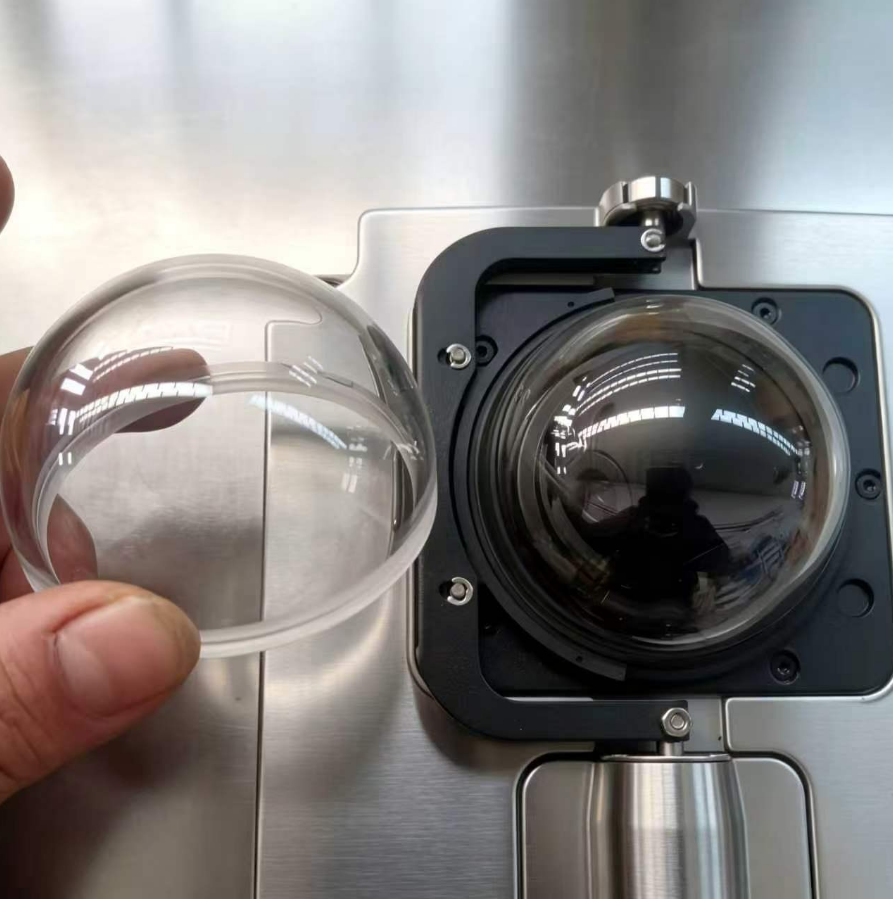
A high-temperature optical sensor depends on a clear path between the process and the detector. The protective window may face furnace radiation, hot gas, pressure, vibration, abrasive particles, cleaning chemicals, and repeated starts and stops. If that window changes shape, develops surface damage, contaminates, or shifts the optical signal, the sensor can drift even when the detector remains functional.
Procurement teams often ask which material “handles more heat.” That question is incomplete. A useful engineering decision also considers thermal gradients, clear-aperture size, thickness, edge support, seal material, pressure differential, spectral band, coating limits, crystal orientation, surface finish, and allowable wavefront error. A material reference point such as a softening point or melting point is not the same as a qualified continuous operating temperature for an assembled sensor.
2. Sapphire vs Fused Silica at a Glance
| Selection factor | Fused silica | Single-crystal sapphire | Design implication |
|---|---|---|---|
| Thermal expansion | Very low | Higher and orientation-dependent | Fused silica generally produces less dimensional change during thermal cycling. |
| Thermal conductivity | Low | Much higher at room temperature | Sapphire can spread local heat; fused silica can maintain a larger temperature gradient. |
| Hardness and wear | Good for glass, but vulnerable to severe abrasion | Very high hardness | Sapphire is favored for dirty, erosive, or contact-wear environments. |
| Optical behavior | Amorphous and isotropic; low birefringence grades available | Anisotropic crystal; orientation matters | Polarization-sensitive systems require explicit sapphire orientation control. |
| Spectral use | Strong option from deep UV through visible and into IR, grade-dependent | Broad UV-to-IR transparency, grade and thickness dependent | Match the actual detector band, thickness, coating, and absorption features. |
| Mechanical stiffness | Moderate | High | Sapphire can support higher load at a given geometry, subject to flaw control and mounting stress. |
| Fabrication economics | Generally easier and more economical | Slower machining and polishing; orientation adds control steps | Total cost should include replacement interval and downtime, not only piece price. |
3. Technical Data Table for Early-Stage Engineering
The values below are representative material data from official Corning HPFS fused silica and KYOCERA single-crystal sapphire references. They support screening, not final design certification. Values vary with grade, crystal axis, test method, temperature, thickness, surface condition, and supplier specification.
| Property | Corning HPFS industrial fused silica | KYOCERA single-crystal sapphire | Engineering note |
|---|---|---|---|
| Density | 2.201 g/cm³ | 3.97 g/cm³ | Sapphire increases component mass for equal volume. |
| Young’s modulus | 72.7 GPa | 470 GPa | Sapphire is substantially stiffer; stress concentration still requires analysis. |
| Hardness | Knoop 522 kg/mm², 100 g load | Vickers 22.5 GPa, HV1 | Different test methods prevent a simple numeric ratio; sapphire is the stronger wear candidate. |
| Thermal conductivity at about room temperature | 1.30 W/(m·K) | 42 W/(m·K) at 20°C | Sapphire spreads heat more efficiently; conductivity changes with temperature. |
| Linear thermal expansion | 0.57 × 10⁻⁶/K from 0–200°C | 7.7 × 10⁻⁶/K parallel to c-axis and 7.0 × 10⁻⁶/K perpendicular, 40–400°C | Sapphire expansion is anisotropic; compare values only with their stated ranges. |
| High-temperature material reference | Softening point 1585°C; annealing point 1042°C; strain point 893°C | Melting point 2053°C | These are different physical definitions and are not assembly service-temperature ratings. |
| Flexural or rupture reference | Abraded modulus of rupture 52.4 MPa | Flexural strength 690 MPa | Surface finish, edge quality, proof testing, and part geometry strongly affect brittle-material strength. |
Reference basis: Corning HPFS Industrial Grade data and KYOCERA Single-Crystal Sapphire technical data. Final drawings should identify the exact material grade and acceptance test.
4. Thermal Performance: Expansion, Heat Flow, and Thermal Shock
Fused silica’s principal thermal advantage is extremely low expansion. When a sensor cycles between ambient and process temperature, the optical path and window geometry can remain comparatively stable. Low expansion also reduces mismatch strain in some mounts, although the seal and metal housing must still be modeled. This is especially valuable where the detector measures small optical changes and window distortion would introduce error.
Sapphire approaches the problem differently. Its room-temperature thermal conductivity is far higher, allowing heat to spread away from a hot spot. Its high stiffness and strength can support demanding pressure and load cases. However, sapphire expands more than fused silica, and its properties depend on crystal direction. A designer should not assume that high melting point automatically means better thermal-shock performance in every geometry.
Fused silica thermal risk
Low conductivity can create a steep temperature gradient if one area is heated rapidly while the edge remains cool. Edge chips, mounting pressure, and localized contamination can become crack origins.
Sapphire thermal risk
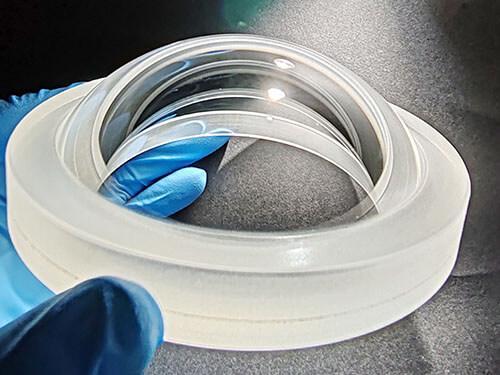
Orientation-dependent expansion and a rigid mount can generate stress. Coatings, brazed features, and metal seals may reach their limits before the sapphire substrate does.
5. Optical Performance: Wavelength, Birefringence, and Coatings
Begin with the detector band and the required signal-to-noise ratio. Fused silica is widely selected for UV and visible systems because high-purity grades can provide high transmission, homogeneity, and low stress birefringence. Infrared performance depends on grade and hydroxyl content, so “fused silica” is not a complete optical specification.
Sapphire transmits over a broad UV-to-IR range and is used for sensing windows in corrosive and wear-intensive environments. Because sapphire is a crystal, its refractive behavior is direction-dependent. Optical axis orientation, polarization sensitivity, wedge, thickness, and angle of incidence should be defined before the drawing is released.
Both materials lose transmission at uncoated surfaces because of reflection. Sapphire’s higher refractive index makes coating strategy particularly important. Specify the operating band, average or minimum transmission, angle range, temperature, environment, and whether the coating must survive cleaning, plasma, humidity, salt, or abrasion. A room-temperature coating certificate does not automatically qualify a window for repeated high-temperature cycling.
6. Mechanical and Environmental Durability
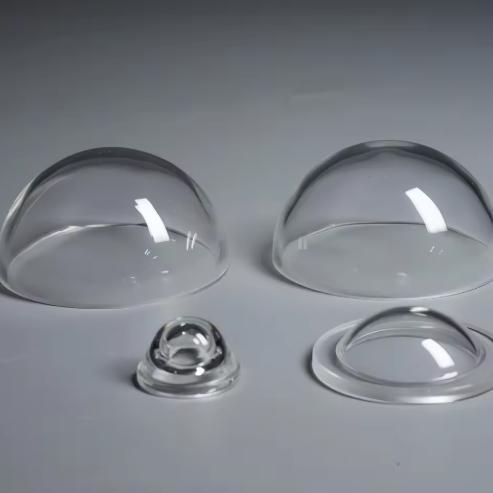
For clean furnaces and protected laboratory instruments, fused silica may provide the needed optical and thermal performance at lower cost. For combustion monitoring, mineral processing, semiconductor chambers, chemical reactors, or exposed field sensors, surface damage can dominate the lifecycle. Sapphire’s hardness and chemical resistance often justify its higher initial cost when abrasion or erosion would gradually scatter light through a fused silica window.
- Pressure: calculate tensile stress using clear aperture, thickness, support condition, pressure differential, and allowable flaw population.
- Particle impact: evaluate velocity, particle size, incidence angle, and whether a sacrificial shield is possible.
- Chemical exposure: identify gases, condensates, cleaning agents, plasma species, humidity, and dwell time.
- Vibration: avoid hard-point clamping and uncontrolled metal-to-window contact.
- Maintenance: define approved cleaning tools and replacement criteria before commissioning.
7. Application-Based Selection Matrix
| Sensor application | Likely starting material | Reason | Critical validation |
|---|---|---|---|
| Protected UV combustion monitor | UV-grade fused silica | UV transmission, low expansion, optical homogeneity | Grade-specific UV transmission, solarization, contamination, coating durability |
| Abrasive furnace or kiln viewport | Sapphire | Hardness, wear resistance, mechanical durability | Thermal gradient, orientation, mount stress, coating temperature |
| Precision pyrometer in a clean enclosure | Fused silica or sapphire | Either may work depending on wavelength and duty cycle | Band transmission at temperature, emissivity effects, window fouling |
| High-pressure chemical reactor sensor | Sapphire | Strength and chemical resistance | Pressure calculation, sealing method, chemical compatibility, proof test |
| Fast thermal cycling with limited abrasion | Fused silica | Very low CTE supports dimensional stability | Temperature ramp, edge condition, mount compliance, hot-spot analysis |
| Plasma or semiconductor chamber window | Sapphire or application-specific fused silica | Choice depends on plasma chemistry, wavelength, and contamination control | Plasma erosion, purity, optical grade, coating and cleaning process |
8. Window Geometry, Crystal Orientation, and Edge Design
Material selection cannot be separated from geometry. Increasing thickness may reduce stress but can change absorption, mass, thermal gradient, and optical path. A smaller clear aperture or improved support can be more effective than simply adding thickness. Chamfers, edge polish, corner radii, wedge, flatness, parallelism, and surface quality should be matched to how the window is loaded and measured.
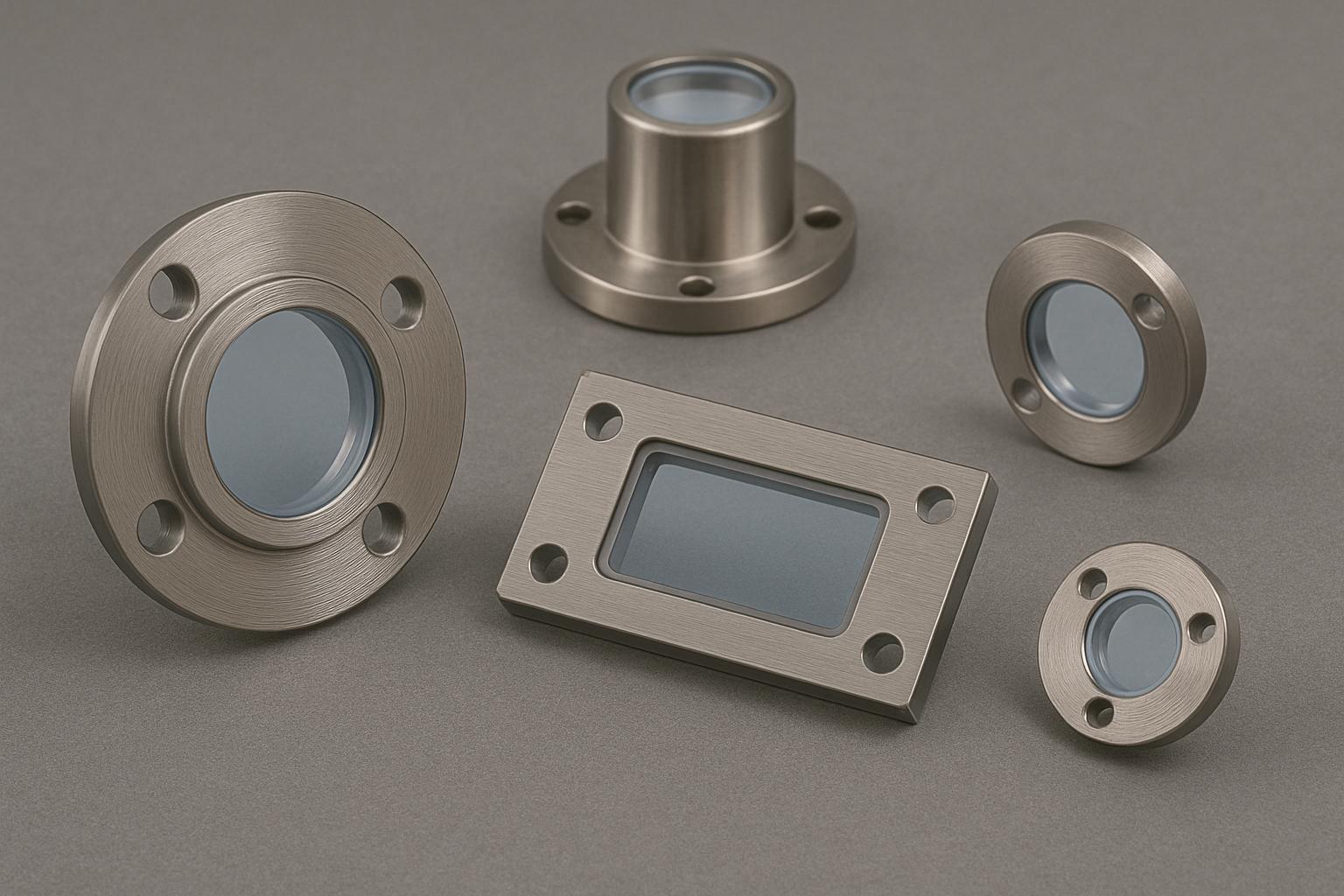
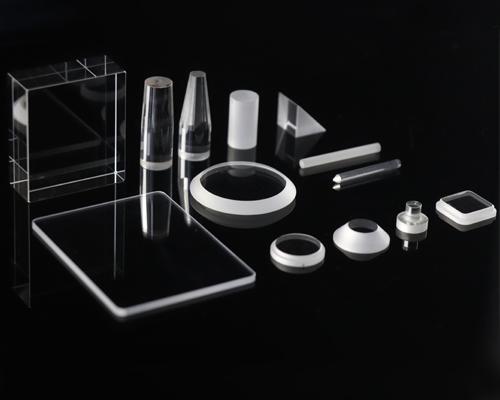
For sapphire, the drawing should define crystal orientation when birefringence, strength, expansion, or processing behavior matters. For fused silica, the grade should define homogeneity, striae, inclusion class, hydroxyl content where relevant, and spectral performance. The Felix Glass product catalog provides a starting point for reviewing available optical component categories, but the final specification should remain drawing-driven.
9. Common Failure Modes and Corrective Actions
Cracking after startup
Likely causes: excessive temperature ramp, rigid clamping, edge chips, seal mismatch, or localized heating. Corrective action: model the transient gradient, add mount compliance, improve edge acceptance, and control ramp rate.
Transmission drift
Likely causes: deposits, coating change, color-center formation, surface erosion, or detector-band mismatch. Corrective action: inspect spectral transmission before and after exposure and define cleaning limits.
Unexpected polarization error
Likely causes: sapphire orientation or stress birefringence was not controlled. Corrective action: specify crystal axis, polarization state, residual stress, and measurement wavelength.
Seal leakage
Likely causes: thermal-expansion mismatch, surface finish, braze or gasket limit, or uneven compression. Corrective action: qualify the full joint through pressure, temperature, and cycle testing.
10. Buyer Specification Checklist
- Define the optical band: center wavelength or full band, incidence angle, polarization, minimum transmission, and allowable wavefront error.
- Define the temperature case: normal, startup, upset, maximum transient, ramp rate, hot-zone map, and cycle count.
- Define mechanical loads: pressure differential, vibration, shock, edge support, clamp load, and safety factor.
- Define the environment: gas chemistry, particles, plasma, humidity, cleaning method, and expected deposits.
- Define material controls: fused silica grade or sapphire orientation, traceability, inclusions, homogeneity, and acceptance tests.
- Define geometry and finish: diameter, thickness, clear aperture, flatness, parallelism, wedge, surface quality, edge finish, and chamfer.
- Define coating requirements: band, reflectance, temperature, adhesion, abrasion, humidity, and cleanability.
- Define assembly validation: proof pressure, thermal cycling, leak rate, spectral verification, and inspection sampling.
Background on manufacturing scope and quality context is available in the Felix Glass company profile. Related engineering articles can be reviewed in the optical materials knowledge center.
11. Frequently Asked Questions
Is sapphire always better for the highest temperature?
No. Sapphire has a high melting point and strong mechanical properties, but the assembly may be limited by crystal orientation, thermal gradient, coating, braze, gasket, housing, or optical requirements. Fused silica can outperform sapphire where very low expansion and optical stability during cycling are more important than abrasion resistance.
Can the softening point of fused silica be used as its continuous operating temperature?
No. Softening point is a viscosity-based material reference. Continuous service temperature must be qualified for the exact grade, load, geometry, surface condition, thermal gradient, mount, seal, coating, and required optical stability.
Which material is better for thermal shock?
Fused silica’s very low CTE is a major advantage during rapid temperature change. Sapphire combines high conductivity, stiffness, and strength, but has higher and anisotropic expansion. The outcome depends on geometry, surface condition, heating pattern, support, and ramp rate, so transient thermal-stress analysis is recommended.
Which material is better for infrared temperature sensing?
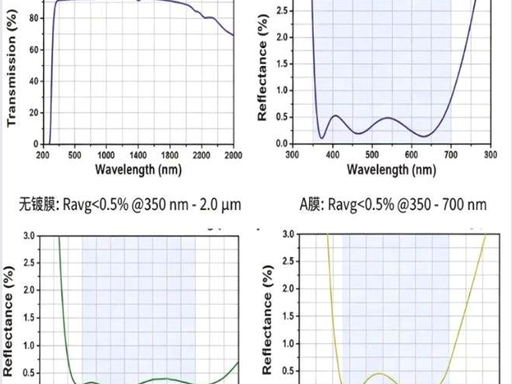
It depends on the exact wavelength band. Sapphire offers broad UV-to-IR transparency, while fused silica grade and hydroxyl content influence infrared performance. Confirm internal and external transmission through the specified thickness, including coating and operating temperature.
What information is needed for a manufacturability review?
Provide a drawing or dimensional sketch, material preference, wavelength band, temperature profile, pressure, environment, clear aperture, surface quality, flatness, coating requirement, quantity, and assembly interface. Engineering questions can be routed through the contact information page, while drawing-based requests are handled through the technical inquiry channel.
12. Engineering Recommendation
Start with fused silica for protected high-temperature sensors where low expansion, UV-visible performance, low birefringence, and cost-effective precision fabrication lead the decision. Start with sapphire where abrasion, erosion, chemical exposure, high pressure, stiffness, or heat spreading controls service life.
Then validate the complete assembly with the actual spectral band, temperature ramp, clear aperture, thickness, edge support, pressure, coating, and seal. A balanced specification normally produces better reliability than selecting either material from a single headline property. General company and navigation information remains available from the Felix Glass home page.