Underwater Optical Domes: Selection Guide
Underwater Optical Domes: Materials, Imaging and Pressure Design
An underwater camera dome does more than keep water away from a lens. Its curved surfaces become part of the imaging system, while its geometry and mounting arrangement influence how the housing carries external pressure. For ROV inspection, AUV surveying and subsea scientific imaging, selecting a dome therefore requires both optical and mechanical information.
The most useful starting point is the application: what the camera needs to see, how it will be mounted and the conditions it must withstand. Material selection follows from those requirements.
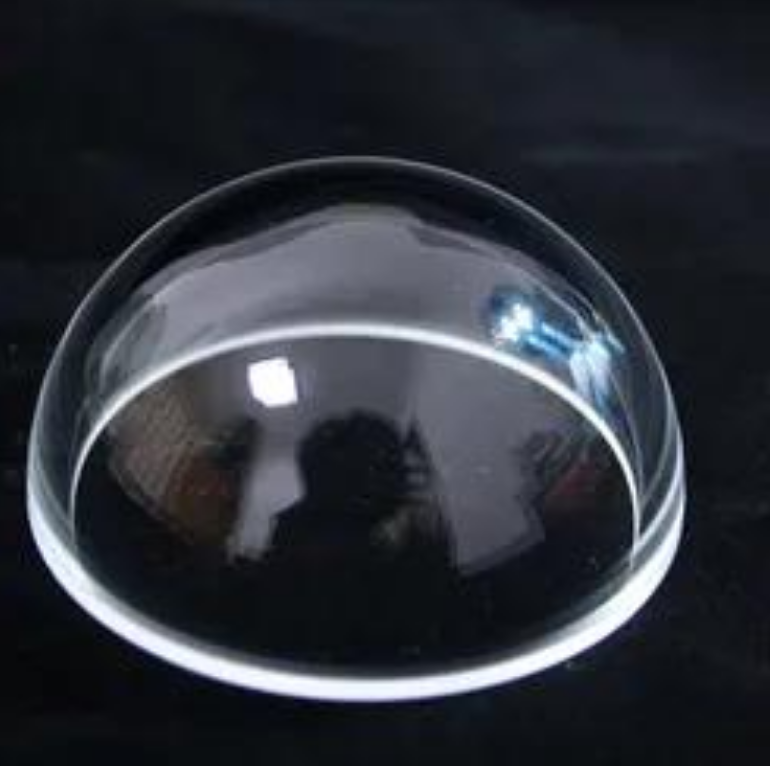
An underwater optical dome, also called a dome port, is a hollow curved window placed in front of a camera or optical sensor. In a typical air-filled housing, incoming light crosses water–glass and glass–air interfaces before reaching the lens.
A dome port is not the same thing as a hydrodynamic fairing. A fairing is an external shell shaped to manage water flow and does not necessarily transmit light or form a pressure boundary. An optical dome may be integrated into a streamlined housing, but its shape alone does not establish reduced drag or a particular operating depth.
For product planning, underwater imaging is best treated as an application of optical dome & optical fairing, with the complete assembly determining its suitability for service.
Water changes how a lens sees through a protective window. Dome-port performance depends on both curved surfaces and the position of the lens behind them.
For a concentric spherical dome, placing the lens entrance pupil near the common center of curvature can reduce chief-ray refraction and help preserve a wide field of view. The relevant reference is the entrance pupil—not simply the front face of the lens or the camera sensor.
This alignment does not make every dome system free of optical errors. Finite-aperture effects, dome geometry, focus behavior and decentering still matter. Underwater photogrammetry and dimensional inspection may require calibration that accounts for the port and its alignment. Research on dome-port cameras identifies these relationships as important sources of imaging error.[1][2]
Useful optical inputs include the lens model, intended focus range, field of view, entrance-pupil location and required image quality. A dome selected only by its outside diameter may fit the housing yet perform poorly with the lens.
No single material is the best choice for every underwater optical system. Compare the required transmission band with surface durability, manufacturing constraints and the proposed structural design.
These are selection considerations, not depth ratings. Sapphire is not automatically qualified for deep-sea use, and BK7-type glass should not be assigned a universal shallow-water limit. The completed component and assembly must be evaluated.
Specify the exact material designation rather than treating BK7, N-BK7, K9 and H-K9L as interchangeable labels. Likewise, use a fused silica designation such as JGS1 only when its documented properties meet the application's requirements. Optical-material references provide a starting point, but the purchased grade and finished component specifications remain decisive.[3]
A request such as “a dome for deep water” leaves several essential questions unanswered. External pressure produces loads that depend on the dome's size and shape, while the mounting seat determines how those loads transfer into the housing.
The structural review should address:
Increasing wall thickness may change optical behavior as well as structural response. It should therefore be evaluated with the lens and housing rather than added as an isolated adjustment.
Deep-sea suitability should be established through an agreed engineering and qualification process for the assembly. A material certificate or a polished appearance is not evidence of a depth rating. The project should also identify who owns structural analysis, housing integration and pressure testing.
Anti-reflection coatings can help control reflections at the dome surfaces, but an underwater dome does not present the same interfaces as a window used entirely in air.
The coating specification should identify the water-facing and air-facing surfaces, working wavelength band and incidence-angle range. A coating designed for an air interface should not be assumed to deliver the same performance when immersed.
Durability requirements are equally relevant. Cleaning methods, sediment exposure and immersion duration should be discussed before a coating is selected. Long-term deployment also raises the question of biofouling. Any requested anti-fouling treatment needs a separate review of its availability, optical effects and compatibility; it should not be assumed to be a standard transparent coating.
A stationary subsea camera and a moving AUV impose different integration requirements. When flow performance is important, the optical dome should be assessed in the context of the surrounding vehicle or housing.
Optical analysis addresses imaging, structural analysis addresses load capacity, and flow analysis addresses the external water flow. The appropriate work depends on the application; not every dome project requires a fully coupled simulation.
Claims such as “low drag” or “cavitation resistant” should be supported by evaluation under defined operating conditions. They should not be inferred from a smooth or pointed product image.
An IR-transmitting dome does not make water transparent to thermal infrared radiation. Water strongly absorbs thermal IR, so conventional 3–5 µm and 8–14 µm cameras cannot observe submerged objects through substantial water paths in the same way they observe targets through air.[4]
Visible-light underwater imaging and airborne infrared imaging should therefore be treated as different application requirements. For a specialized non-visible underwater sensing project, specify the wavelength and water-path length before selecting the dome material.
An effective underwater optical dome enquiry brings together the optical drawing and the operating conditions.
For a custom component enquiry, send your drawing and available requirements to Dongguan Felix Glass Co., Ltd. Material, geometry, coating feasibility and inspection scope can then be discussed for the proposed optical dome.
Email: james@felixglass.com
How to Select an Underwater Optical Dome for ROV and AUV Cameras
What Is an Underwater Optical Dome?
Dome Ports, Refraction and Camera Alignment
Choosing a Dome Material
Material
Reasons to evaluate it
Questions to resolve
Sapphire
High hardness and scratch resistance
Are crystal orientation, optical properties and manufacturing requirements compatible with the design?
Fused silica
Low thermal expansion and suitable UV–visible transmission grades
Which grade and spectral range are required, and does the proposed geometry meet the structural requirements?
BK7-type or H-K9L optical glass
Visible-light imaging and cost-sensitive designs
What exact grade is specified, and what optical and mechanical acceptance criteria apply?
Why Wall Thickness Alone Cannot Define Working Depth
AR Coatings Must Match the Surrounding Medium
When Hydrodynamic Analysis Matters
Can an Underwater Dome Be Used for Thermal Imaging?
What to Include in an RFQ
RFQ Checklist
Phone: +86-18565032888